
Physiotherapy · Treatments
Shockwave Therapy in Milton Keynes: How It Works, What It Treats, and Why It Works Best Alongside Rehab
Written by Nick Allen and Simon Jones
Lead Physiotherapists, Co-Directors Hanbury Health, Milton Keynes
Published:
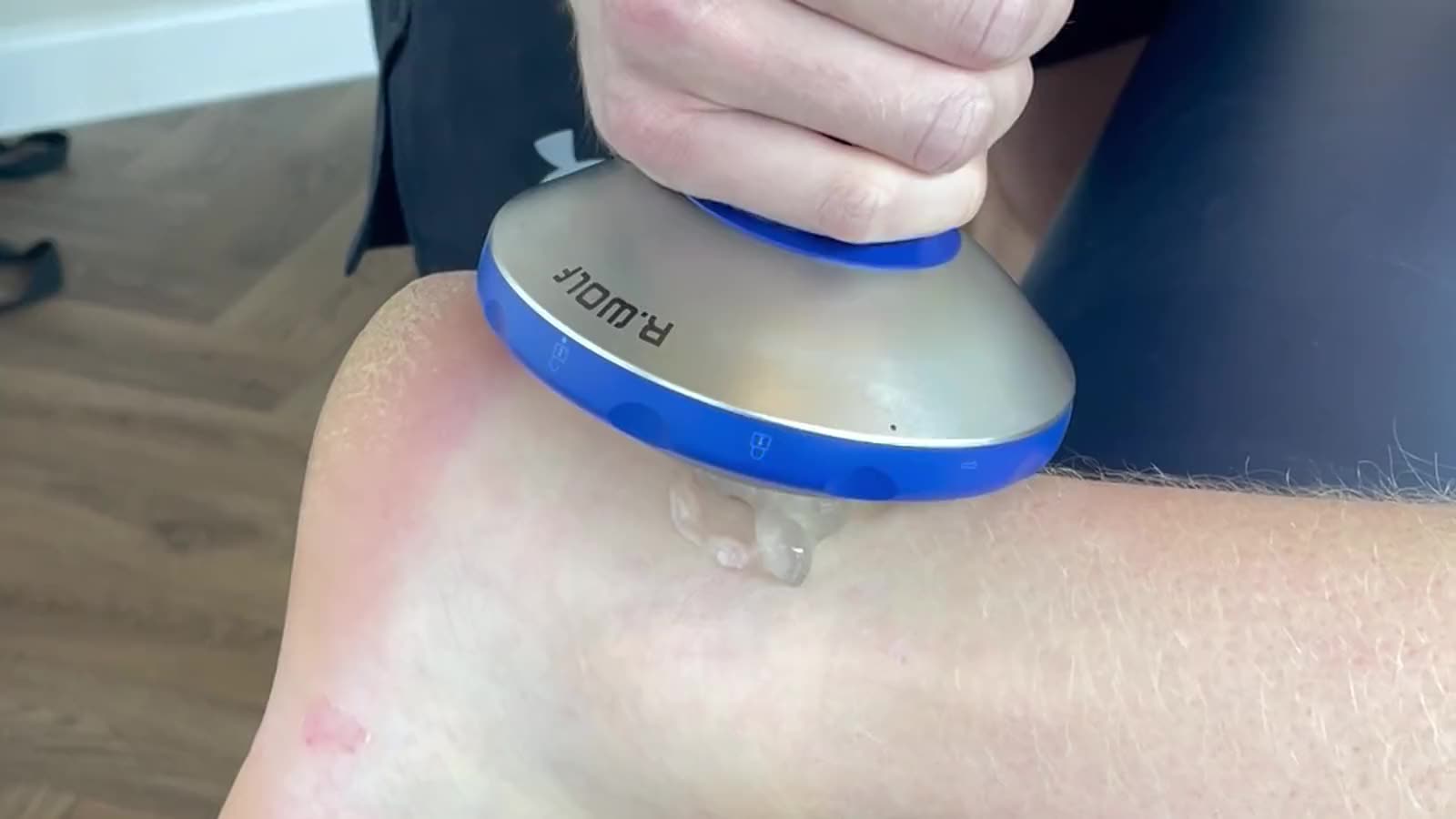
Shockwave therapy has a reputation as a "miracle" for stubborn tendon pain, and any clinic promising a one-off cure is overselling it. Used properly, it restarts healing in a tendon that's got stuck, and takes enough pain out of the way that you can do the strengthening work that actually fixes the problem. At Hanbury Health we offer both radial and focused shockwave, and we use them the way the evidence supports: as an adjunct to focused physiotherapy. Here's how it works, what it helps, and the honest picture on results.
What shockwave therapy is
Shockwave therapy, more precisely extracorporeal shockwave therapy, or ESWT, uses a handheld applicator to deliver rapid, high-energy acoustic (sound) pressure waves through the skin and into the tissue underneath. "Extracorporeal" simply means the energy is generated outside the body and transmitted in. It's the same broad family of technology used to break up kidney stones, adapted and dialled to the right level for musculoskeletal tissue.
It's applied in person by a physiotherapist as part of an assessment-led treatment plan.
How it works
The effect works through mechanotransduction, the process by which cells convert a mechanical signal into a biological response. By delivering a controlled mechanical stimulus to a tendon or its attachment, shockwave prompts several healing responses:
- It restarts a stalled healing process. Chronic tendon problems often aren't "inflamed", they're degenerative and under-healed. The controlled stimulus triggers a fresh repair response where the body had given up.
- It stimulates new blood vessels (neovascularisation). Tendons have a poor blood supply, which is why they heal slowly. Shockwave encourages new micro-vessels, improving the delivery of what the tissue needs to repair.
- It drives collagen and cell activity. It stimulates the tendon cells (fibroblasts/tenocytes) to lay down and remodel healthy collagen.
- It reduces pain. It modulates the nerve endings and pain-signalling chemicals in the area, which is often what buys you the window to load and exercise the tendon again.
- It can help break down calcification. In calcific tendon problems (commonly the shoulder), focused shockwave can help fragment the calcium deposits.
How shockwave supports tendon healing

Targeted pressure waves
Stimulates a healing response
- Supports local circulation
- Supports tissue repair
- May help reduce pain
What we use it for
Shockwave is at its best for long-standing tendon and attachment problems that haven't settled with time and basic treatment. In practice, we use it for:
- Plantar fasciitis / plantar heel pain, one of the best-supported uses.
- Achilles tendinopathy, both mid-portion and insertional.
- Tennis elbow and golfer's elbow (lateral and medial epicondylalgia).
- Gluteal tendinopathy / greater trochanteric pain (pain on the outside of the hip).
- Patellar tendinopathy ("jumper's knee").
- Calcific rotator cuff tendinopathy (calcium in the shoulder tendons).
- Proximal hamstring tendinopathy, and shin pain (medial tibial stress syndrome) in the right cases.
It's generally not the answer for a fresh, acute injury or a simple muscle strain, those need a different approach. We'll tell you if your problem isn't one shockwave suits.
Radial vs focused shockwave, the difference
Not all "shockwave" is the same, and the distinction matters. There are two types, and they behave differently. Having both means we can match the tool to the tissue.
| Radial shockwave (RSWT) | Focused shockwave (fESWT) | |
|---|---|---|
| How the energy is made | A projectile driven by compressed air strikes an applicator on the skin | Generated electromagnetically, electrohydraulically or piezoelectrically and focused to a point |
| Energy pattern | Disperses and spreads outward; peak energy is at or near the skin surface | Converges to a precise focal point at a set depth |
| Depth | Shallower, best for tissue nearer the surface (roughly up to 3–4 cm) | Deeper and targeted, can reach several centimetres down |
| Best suited to | Broader or more superficial areas, plantar fascia, elbow tendons, shin, larger muscle regions and trigger points | Deep or precisely located targets, deep tendon insertions, calcific deposits, focal "hot spots" |
| Character | Broader, lower-pressure, more diffuse | Higher peak pressure, more precise, more penetrating |
Neither is simply "better." Radial is excellent and often the right choice for superficial, spread-out problems; focused earns its place when we need to reach deep or hit a small, specific target such as a calcium deposit. Part of our assessment is deciding which, or which combination, fits your problem.

An adjunct to rehab, not a shortcut
This is the part we won't let you skip, because it's the difference between a lasting result and a temporary one. Shockwave does not, on its own, fix a tendon. Tendons get stronger and more resilient through progressive loading, the right strengthening exercises, at the right dose, over time. That is what resolves tendinopathy.
What shockwave does is make that rehab work better and faster: it kick-starts the biological healing and takes enough pain out of the way that you can actually do the loading programme your tendon needs. Used without a focused rehabilitation and strengthening programme around it, the benefit tends to fade. Used as an adjunct to one, it can be the thing that finally gets a stubborn tendon moving in the right direction. Every course of shockwave we deliver comes attached to a rehab plan, because that's how the treatment is supposed to work.

What the evidence shows
We'll give you the honest version. For chronic tendinopathies, shockwave has a reasonable and growing evidence base, the strongest for plantar fasciitis and for calcific rotator cuff tendinopathy, with supportive evidence for Achilles, patellar and elbow tendon problems. Recent systematic reviews and meta-analyses report meaningful reductions in pain and improvements in function across these conditions, for both radial and focused shockwave, and UK practice recognises it as a reasonable option for persistent cases that haven't responded to first-line care.
The honest caveats: study quality varies, protocols differ between trials, and results aren't universal, some people respond well, some modestly, some not at all. It typically takes a course of around three to five weekly sessions before you know, and improvement often continues for weeks after the course finishes. And, to repeat the key point, the evidence is strongest when shockwave is combined with a loading and strengthening programme. That's exactly how we deliver it.
What a session is like
After assessing you and confirming shockwave is appropriate, we locate the target area, apply gel, and deliver the pressure waves through the applicator, usually a few minutes per area. You'll feel a firm tapping and some discomfort over the sore spot; we adjust the intensity to a level you can tolerate, and it's over quickly. It's normal to feel a bit sore or achy for a day or two afterwards, and we'll usually ask you to avoid anti-inflammatory painkillers around your sessions, because a degree of inflammation is part of how it works. A typical course is around three to five sessions, roughly a week apart, alongside your rehab.
Who it's for, and who it's not
Shockwave suits people with a long-standing tendon or attachment problem that hasn't settled with time, activity modification and basic rehab. It isn't suitable for everyone. Tell us before treatment if you are pregnant, have a blood-clotting disorder or take blood-thinning medication, have a local infection or cancer in the area, have had a cortisone injection in the area recently, or if the painful area is over a growth plate (in younger patients), a nerve, or a major blood vessel. We assess everyone first and will tell you honestly if it isn't right for you.
Frequently asked questions
What is shockwave therapy?
Shockwave therapy (ESWT) uses acoustic pressure waves delivered through the skin to stimulate the body's healing response in tendons and reduce pain. It's used mainly for long-standing tendon problems, as part of a physiotherapy plan.
What does shockwave therapy treat?
It's most effective for chronic tendinopathies, plantar fasciitis, Achilles, tennis and golfer's elbow, gluteal (hip) and patellar tendon pain, and calcific rotator cuff tendinopathy in the shoulder. It's not for fresh acute injuries or simple muscle strains.
What's the difference between radial and focused shockwave?
Radial shockwave spreads its energy from the skin surface and is best for more superficial, broader areas. Focused shockwave concentrates energy to a precise point at depth, so it's better for deep or pinpoint targets such as calcium deposits. We offer both and choose based on your problem.
Does shockwave therapy work on its own?
No, and that's important. It's an adjunct that kick-starts healing and reduces pain so you can do the strengthening rehab that actually resolves a tendon problem. We always deliver it alongside a loading and rehabilitation programme.
Does it hurt, and how many sessions will I need?
You'll feel a firm tapping and some discomfort over the sore area, adjusted to your tolerance, and you may be a little sore for a day or two afterwards. Most people have a course of around three to five weekly sessions, with improvement often continuing for weeks after.
Is shockwave therapy safe? Who should avoid it?
It's well tolerated, but not for everyone. Avoid it, or check with us first, if you're pregnant, have a clotting disorder or take blood thinners, have an infection or cancer in the area, had a recent cortisone injection there, or the area is over a growth plate, nerve or major vessel. We assess suitability before treating.
Where can I get shockwave therapy in Milton Keynes?
Radial and focused shockwave therapy is available within physiotherapy at Hanbury Health, Milton Keynes. Book a physiotherapy assessment through our website.
Book a physiotherapy assessment in Milton Keynes
If you've got a stubborn tendon problem that won't settle, book a physiotherapy assessment with our team at Hanbury Health. We'll work out what's going on, tell you honestly whether shockwave will help, and build it into a proper rehabilitation plan if it will.
Medical disclaimer: Shockwave therapy is delivered here within physiotherapy, applied and supervised by a physiotherapist as part of an individual assessment and treatment plan. It is not a standalone cure, individual results vary, and it is not a substitute for medical advice. Always consult a qualified clinician about your circumstances, particularly if you are pregnant, take blood-thinning medication, or have a clotting disorder, infection or cancer in the area.
Written by Nick Allen and Simon Jones, Physiotherapists at Hanbury Health, Milton Keynes.