
Physiotherapy
What to expect at your first physiotherapy appointment in Milton Keynes

The short version
- The first appointment is mostly assessment: conversation, examination, then explanation and plan.
- Wear comfortable, loose clothing so the relevant area can be examined.
- Bring details of your problem, relevant history, any scans, and your questions.
- You should leave understanding your diagnosis and the plan, including what to do yourself.
- It should not be an ordeal; anything uncomfortable is done carefully and with your consent.
Your first physiotherapy appointment is mostly an assessment: a conversation about your problem, a physical examination of how you move, and then a clear explanation of what is going on and a plan to fix it. Many people are unsure what to expect, or worry it will be uncomfortable or confusing, so knowing the shape of it helps you turn up relaxed and get the most from it. By the end, you should understand your diagnosis, what is likely causing it, and the plan, including what you can do yourself.
Before you go: wear comfortable, loose clothing you can move in, so the relevant area can be examined; bring details of your problem, any relevant history and scans, and your questions.
The conversation
The appointment starts with a detailed conversation, because your story usually points to the diagnosis before any hands-on examination. Your physiotherapist will ask how the problem started, what makes it better or worse, how it affects your daily life and activities, your relevant medical history, and, importantly, what you want to get back to. This is not small talk; it is a core part of the diagnosis. Being ready to describe your symptoms and your goals helps you get an accurate assessment and a plan aimed at what matters to you.
The physical examination
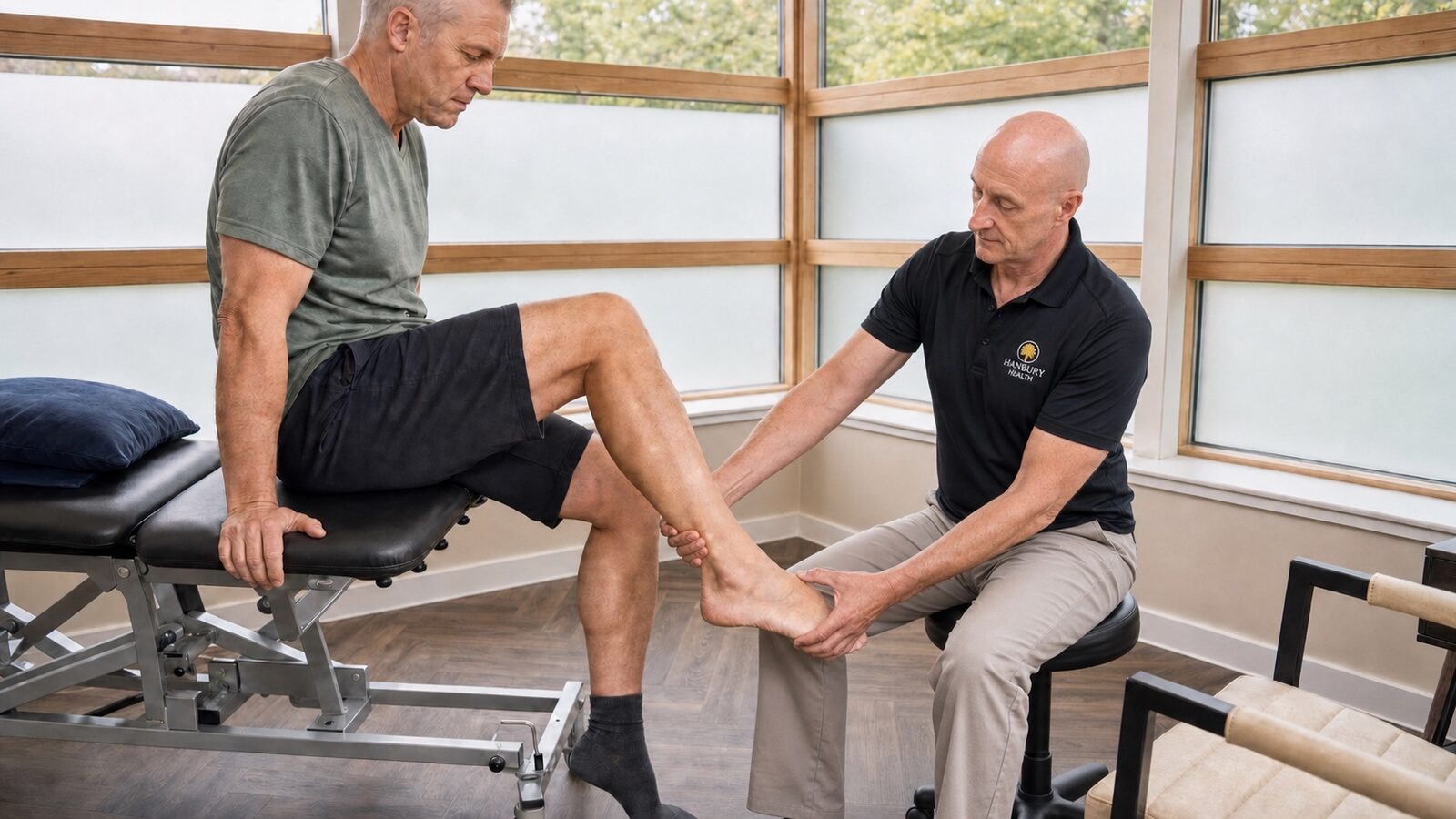
Next comes a physical examination, which is why loose, comfortable clothing helps: the physiotherapist needs to see and assess the relevant area. They will typically look at how you move, test your range of movement, strength and control, and perform specific tests to reproduce or narrow down the problem. Where useful, objective measures may be added, such as force-plate or other testing, and, where it helps, imaging such as diagnostic ultrasound to look directly at the tissue. It should not be an ordeal; anything uncomfortable is done carefully and with your consent.
The explanation and plan
The most valuable part comes at the end: a clear explanation of what is going on, in plain language, and a plan. You should leave understanding your likely diagnosis, what is causing it, a realistic idea of the timescale, and the plan itself, usually including exercises or actions to start straight away. A good physiotherapist makes you an active partner in your recovery, so you know what to do between appointments, not just a passive recipient of treatment. If anything is unclear, ask, this is exactly the time.
Why Hanbury Health is different
A first appointment at Hanbury is designed to give you clarity and momentum. You are assessed by an experienced team with, where useful, diagnostic ultrasound and objective testing on hand to sharpen the diagnosis on the day, and overseen by a consultant surgeon, so you can be confident the diagnosis is accurate and the plan is right, including honest advice if your problem needs a different pathway. You should leave your first visit knowing what is wrong, why, and exactly what happens next. See how our physiotherapy service in Milton Keynes is set up, or read our companion pieces on when to see a physiotherapist and do you need a referral for physiotherapy .
Frequently asked questions
What happens at a first physiotherapy appointment?
A detailed conversation about your problem, a physical examination of how you move, and then a clear explanation of your diagnosis and a plan, often including exercises to start straight away.
What should I wear to physiotherapy?
Comfortable, loose clothing you can move in, so the relevant area can be examined. For a knee, for example, shorts are ideal.
What should I bring?
Details of your problem and how it started, any relevant medical history or medications, any scan results you have, and your questions and goals.
Will the first appointment hurt?
It should not be an ordeal. Some tests may briefly reproduce your symptoms, but they are done carefully and with your consent.
Where can I book a first physiotherapy appointment in Milton Keynes?
Hanbury Health in Milton Keynes offers physiotherapy assessment, with diagnostic ultrasound and objective testing available on site.
References
Ready to put this into practice?
Hanbury Health is the only place in Milton Keynes where physiotherapy is overseen by a foot-and-ankle surgeon, with on-site diagnostic ultrasound and a surgeon-led pathway if you ever need more than physiotherapy.
About the author: Nick Allen is a director of Hanbury Health and a Chartered Physiotherapist (BSc (Hons), HCPC-registered, MCSP), with extensive experience in professional and endurance sport, currently Lead Physiotherapist for Great Britain Badminton. Rehabilitation across the physiotherapy service is medically reviewed by Prof Arul Ramasamy, a consultant foot-and-ankle surgeon.
General information, not medical advice. Written by Nick Allen. Medically reviewed by Prof Arul Ramasamy MA PhD MBA FRCS(Tr+Orth). Last reviewed: 25 July 2026.
Related insights

Physiotherapy
How do you know you're ready to return to sport after injury?
Why a calendar date is the wrong marker, what strength, movement and psychological testing actually shows, and how the gap between pain-free and match-fit gets closed.
Allen9 min readRead the article

Physiotherapy
Achilles tendon rupture in Milton Keynes: recovery and rehabilitation
Recognising a rupture, the surgery-or-not decision, and the staged rehabilitation that largely determines the outcome.
Jones9 min readRead the article
Physiotherapy
What causes Achilles tendinopathy, and why does loading beat rest?
What Achilles tendinopathy actually is, why rest alone rarely fixes it, and the loading programme that gives you the best chance of a full recovery.
Jones9 min readRead the article


Stay informed
More from the Hanbury team.
New articles on recovery, movement, physiotherapy and performance, sent when there's something worth reading. No spam, unsubscribe any time.