
Physiotherapy
How do you know you're ready to return to sport after injury?

The short version
- "How many weeks until I am back?" is the wrong question. "What does the testing show?" is the right one.
- Being pain-free does not mean your strength, control, or confidence have caught up, even though it feels like it should.
- Testing, strength, movement, and psychological readiness, gives an honest answer where guesswork can miss a hidden gap.
- The research is not unanimous, but the strongest studies show returning without meeting proper criteria carries a clearly higher reinjury risk.
- Hanbury Health's Return to Sport Protocol is built entirely around closing this gap, with direct surgical input if you have needed it.
You are ready to return to sport when testing shows your strength, movement, and confidence have actually caught up with the demands of your sport, and that is a different question from how many weeks have passed since your injury or surgery. Being pain-free is a good sign, but it does not mean you are match-fit, and the gap between the two is where most reinjuries happen.
Why isn't "the pain's gone" good enough?
It is completely understandable to think that once something stops hurting, you are fixed. Pain is an alarm system, and alarms can switch off before the underlying problem is fully resolved. You can walk normally, climb stairs, and get through your day pain-free while your injured leg still produces noticeably less force than your uninjured one under the kind of sudden loading that sport demands. You would never notice that gap in daily life, but it matters the first time you plant your foot to change direction at speed.
Why isn't "twelve weeks" or "back for the new season" a good enough answer either?
Because recovery timelines describe averages, not you specifically. Two people recovering from the same surgery, both told "twelve weeks", can be in completely different physical positions by that date: one might have regained 95% of the strength and control in the injured leg compared with the healthy one, the other might only be at 70%. If both are sent back to sport on the same calendar date, one of them is carrying a hidden, preventable risk. Return to sport should follow what your body has actually shown it can do, not the date on a calendar (Ardern et al, 2016).
What does proper testing actually involve?
Three things, looked at together.
Strength and symmetry, measured under load, typically with force plate and objective strength testing, comparing your injured leg directly against your uninjured one. This produces a limb symmetry index: a percentage showing how close the injured side is to matching the healthy side, and it is one of the most consistently used markers in the research (Grindem et al, 2016).
Movement quality, assessed separately through motion and gait analysis while you land, decelerate, and change direction. A leg can test strong sitting still on a machine while still moving poorly the moment you are asked to cut and pivot at speed, and that is exactly the moment injuries happen.
Psychological readiness. This one surprises people, but the evidence is fairly clear: athletes who do not feel genuinely confident and ready to return, even when their body has hit every physical marker, face a measurably higher risk of a second injury (McPherson et al, 2019). Confidence is a real, measurable part of readiness here, not an afterthought.
What symmetry score counts as "ready"?
Most return to sport research points to a limb symmetry index of around 90% or higher on strength and jump testing as one of the key markers (Grindem et al, 2016). It is used alongside movement quality and psychological readiness rather than as a standalone pass or fail line, but it gives a clear, comparable number that a subjective "it feels okay" check cannot provide. Our guide to ACL reconstruction rehabilitation stage by stage shows how those thresholds are applied through a longer recovery.
Does skipping proper testing actually raise your risk of getting hurt again?
The evidence points that way overall, though it is worth knowing both sides. Some of the strongest studies show a clear link: one found that following simple, criteria-based return to sport rules cut reinjury risk by 84% after ACL reconstruction (Grindem et al, 2016), and another found that people who did not meet a set of clinical discharge criteria before returning had around four times the risk of graft rupture compared with those who did (Kyritsis et al, 2016). A separate meta-analysis pooling several studies found the picture less clear cut, without a statistically significant reduction in reinjury risk from passing testing criteria alone (Losciale et al, 2019). Taken together, this is why testing is not treated as a single magic number here: it is one part, alongside movement quality, psychological readiness, and experienced clinical judgement, of a genuinely safe return.
Where can I get this kind of testing done in Milton Keynes?
This is exactly what the Hanbury Return to Sport Protocol is built for: a five-stage, testing-led pathway using strength testing, movement analysis, and psychological readiness checks at every stage, run in a purpose-built rehabilitation gym, with direct access to a consultant orthopaedic surgeon if your injury needed one. It sits within physiotherapy at Hanbury Health in Milton Keynes, so the testing, the rehab, and any surgical input all run through the same team.
How do I book an assessment?
You can book directly through Cliniko for an initial physiotherapy assessment. From there, your clinician builds a testing and training plan specific to your injury, surgery history if relevant, and sport. It starts with a single assessment, with no requirement to commit to the full protocol upfront. If you are not sure whether physiotherapy or an operation is the right next step, our guide to deciding between surgery and physiotherapy is a good place to start.
Why Hanbury Health is different
A lot of return to sport advice still comes down to a generic timeline, handed out regardless of how your body has actually responded. What is different here starts with experience: the founding team has a combined 40 years working in professional sport, so the standard applied to your recovery is the same one used with professional athletes. If your injury involved surgery, you have direct access to the consultant who performed it throughout your rehab, rather than a referral into a separate system to find your own way back. And because physiotherapy, movement coaching, and surgical input all sit under one roof, working from the same testing data, a concerning result changes what happens in your very next session. The aim is to close the real gap between recovering from an injury and being properly ready, physically and mentally, to perform at full fitness without carrying a heightened risk of breaking down again.
Don't guess your way back. Test your way back, with the surgeon in the room.
Frequently asked questions
Is this only relevant after ACL surgery?
No. The same principle, testing over a calendar guess, applies to ankle, hamstring, shoulder, and general soft-tissue injuries, with the specific tests adapted to the joint and sport.
Can I still return to sport if I don't hit every threshold?
Often, yes, with modified activity and a clear plan to close the remaining gap. This is a clinical decision made together with you.
How is this different from a normal physiotherapy check-up?
A standard check-up relies mostly on clinical judgement and how you say you feel. A return to sport testing battery adds objective, measured data, strength, symmetry, and movement quality, alongside that judgement, so the decision is not resting on feel alone.
Does private testing get me back faster than an NHS pathway?
The aim is a more accurate answer, not simply a faster one. That can mean returning sooner with genuine confidence, or holding back a stage that a generic timeline would have missed.
Do I need a referral from a doctor or surgeon?
No, you can book a physiotherapy assessment directly in Milton Keynes.
If I do need surgery, will I be passed between different providers?
No. Consultant orthopaedic input is part of the same pathway from the start, so the person overseeing any surgery is also involved in your return to sport decisions.
References
- Ardern CL, Glasgow P, Schneiders A, et al. 2016 Consensus statement on return to sport from the First World Congress in Sports Physical Therapy, Bern. British Journal of Sports Medicine, 2016;50:853-864.
- Grindem H, Snyder-Mackler L, Moksnes H, Engebretsen L, Risberg MA. Simple decision rules can reduce reinjury risk by 84% after ACL reconstruction: the Delaware-Oslo ACL cohort study. British Journal of Sports Medicine, 2016;50:804-808.
- Kyritsis P, Bahr R, Landreau P, Miladi R, Witvrouw E. Likelihood of ACL graft rupture: not meeting six clinical discharge criteria before return to sport is associated with a four times greater risk of rupture. British Journal of Sports Medicine, 2016;50:946-951.
- Losciale JM, Zdeb RM, Ledbetter L, Reiman MP, Sell TC. The association between passing return-to-sport criteria and second anterior cruciate ligament injury risk: a systematic review with meta-analysis. Journal of Orthopaedic and Sports Physical Therapy, 2019;49(2):43-54.
- McPherson AL, Feller JA, Hewett TE, Webster KE. Psychological readiness to return to sport is associated with second anterior cruciate ligament injuries. American Journal of Sports Medicine, 2019;47(4):857-862.
- NHS. Sports injuries: recovery and returning to activity.
Ready to put this into practice?
Hanbury Health is the only place in Milton Keynes where physiotherapy is overseen by a foot-and-ankle surgeon, with on-site diagnostic ultrasound and a surgeon-led pathway if you ever need more than physiotherapy.
About the author: Nick Allen is a director of Hanbury Health and a Chartered Physiotherapist (BSc (Hons), HCPC-registered, MCSP), with extensive experience in professional and endurance sport, currently Lead Physiotherapist for Great Britain Badminton. Rehabilitation across the physiotherapy service is medically reviewed by Prof Arul Ramasamy, a consultant foot-and-ankle surgeon.
General information, not medical advice. Written by Nick Allen. Medically reviewed by Prof Arul Ramasamy MA PhD MBA FRCS(Tr+Orth). Last reviewed: 25 July 2026.
Related insights
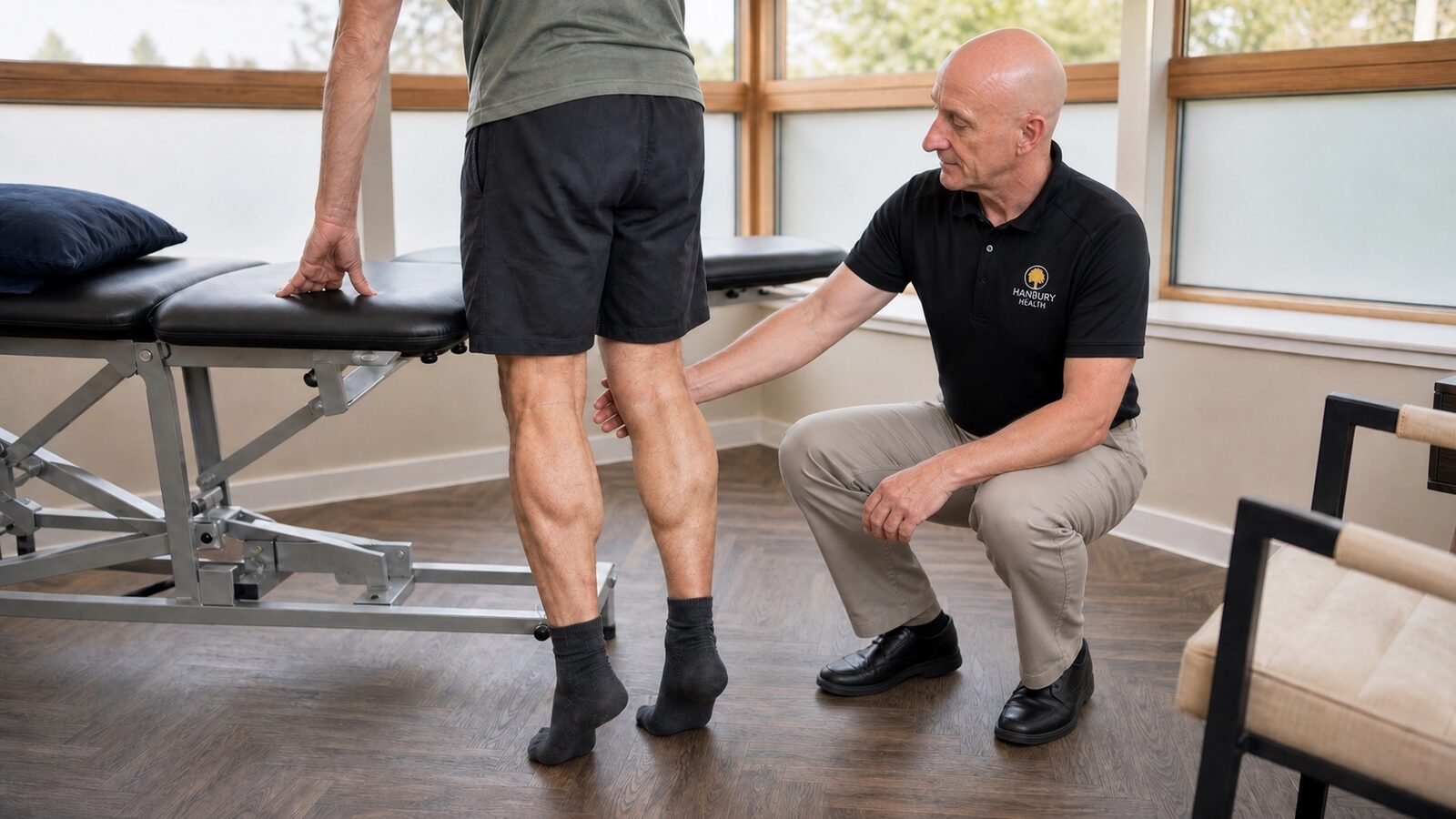
Physiotherapy
Achilles tendon rupture in Milton Keynes: recovery and rehabilitation
Recognising a rupture, the surgery-or-not decision, and the staged rehabilitation that largely determines the outcome.
Jones9 min readRead the article
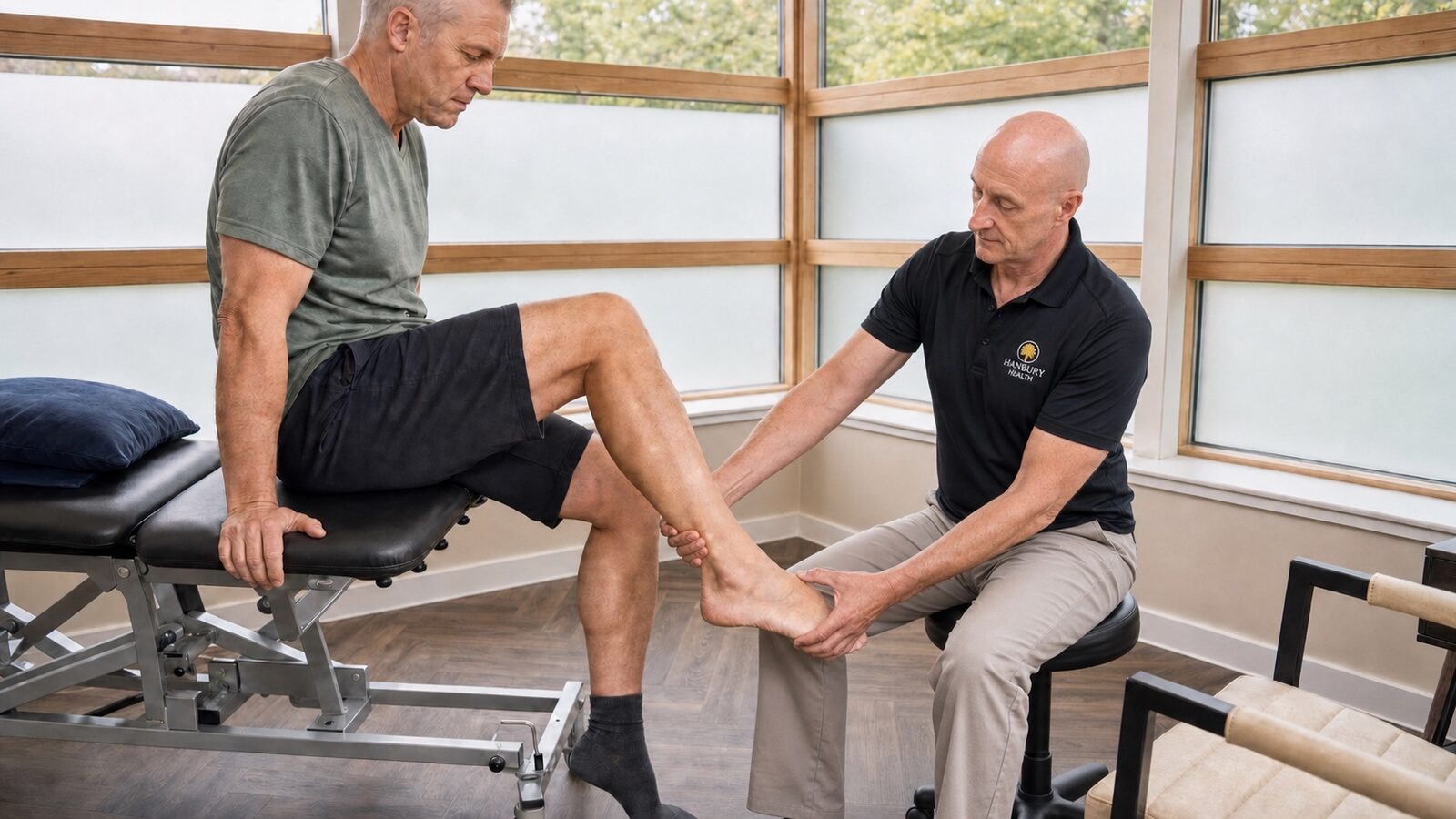
Physiotherapy
What causes Achilles tendinopathy, and why does loading beat rest?
What Achilles tendinopathy actually is, why rest alone rarely fixes it, and the loading programme that gives you the best chance of a full recovery.
Jones9 min readRead the article
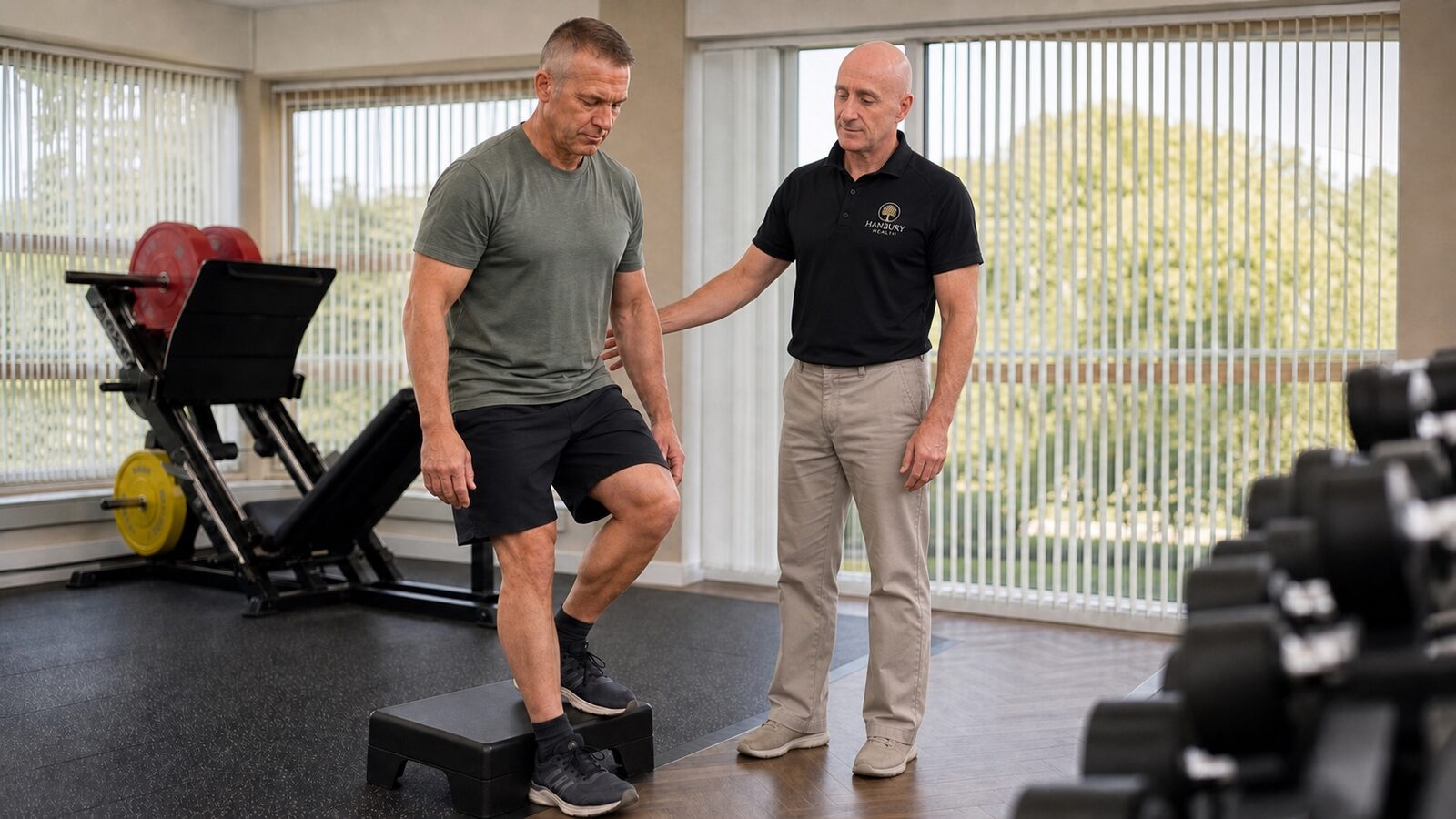
Physiotherapy
Rehab after ACL reconstruction in Milton Keynes: from surgery to return to sport
The staged journey after ACL reconstruction: early quadriceps reactivation, rebuilding strength and control, and criteria-based return to sport.
Allen10 min readRead the article


Stay informed
More from the Hanbury team.
New articles on recovery, movement, physiotherapy and performance, sent when there's something worth reading. No spam, unsubscribe any time.