
Physiotherapy
Movement and gait analysis in Milton Keynes: how it improves rehabilitation

The short version
- Movement and gait analysis objectively assesses how you move, walk and run.
- Many injuries are driven by how you load tissue, not just the tissue itself.
- Technology such as 3D motion capture reveals patterns the eye can miss.
- Findings make rehabilitation and technique changes targeted, not generic.
- Especially valuable for runners and for return-to-sport decisions.
Movement and gait analysis means objectively assessing how you move, walk and run, so a physiotherapist can see the patterns that cause or perpetuate pain and injury, instead of relying on the eye alone. Many injuries, especially in runners, are driven by how you load tissue as much as by the tissue itself, and the way you move can either protect or overload a joint. Analysing movement, including with technology such as 3D motion capture, turns "you move a bit awkwardly" into specific, measurable findings, so rehabilitation and any technique changes can be targeted at what is actually driving your problem.
Why how you move matters
Pain is often the end result of a chain of movement, and rarely just a local problem. A runner's knee pain, for example, may be driven by how the hip and trunk control the leg during running, and back or lower-limb problems frequently trace to movement patterns that repeatedly overload a structure. Treating the sore spot while ignoring the movement that loads it tends to leave the problem returning. Understanding the pattern, how you distribute load as you move, is often the key to fixing the cause instead of chasing the symptom. Ferber and colleagues (2010) showed exactly this in competitive female runners: those with a history of iliotibial band syndrome demonstrated atypical hip and knee kinematics compared with uninjured runners.
What analysis reveals
Assessing movement, from a simple squat or single-leg task to full running gait, can reveal things like asymmetries between sides, poor control at the hip or trunk, how you absorb landing forces, and inefficiencies in your running technique. The naked eye catches some of this, but movement happens fast and in three dimensions, so a lot is missed. Technology such as 3D motion analysis captures what the eye cannot, producing objective, repeatable measurements that matter both for pinpointing the cause and for checking whether it has actually improved. This kind of objective measurement is well established in rehabilitation science more broadly: instrumented gait analysis is precise enough that marker tracking is no longer the limiting factor, though as with any clinical measurement, reliable, meaningful results depend on technique and interpretation as well as the equipment. One recent observational study of 150 athletes found that reduced joint mobility and gait asymmetry were independently associated with higher injury rates, with the risk compounding sharply when both were present together.
How it changes your rehab
The point of analysis is a better, more targeted plan. If your knee pain is driven by hip control, the programme focuses there; if your running gait is overloading a structure, specific technique cues and drills are added. Because the assessment is objective and repeatable, progress can be re-measured rather than guessed, so you know the change has actually happened. For runners and for anyone returning to sport, this turns rehabilitation from generic exercises into a plan aimed at your particular movement.
Why Hanbury Health is different
Objective assessment is part of how we work here, applied as standard, not an occasional extra. At Hanbury we combine movement and gait analysis, including 3D movement analysis with HumanTrak and force-plate testing with VALD, so how you move and how you load are both measured directly. That means rehabilitation aimed precisely at what is driving your problem, and return-to-sport and progress decisions based on data. Delivered by a team with deep experience in running and sport, it is the difference between treating the sore area and fixing the cause. See how our physiotherapy service in Milton Keynes is set up, or read our companion pieces on runner's knee and force plate testing for ACL return to sport .
Frequently asked questions
What is gait analysis?
An objective assessment of how you walk or run, used to identify movement patterns that cause or perpetuate pain and injury, so rehabilitation can be targeted at the cause.
Who benefits from movement or gait analysis?
Especially runners and people with recurring or hard-to-resolve lower-limb pain, and anyone making return-to-sport decisions, but it is useful whenever how you move is part of the problem.
How is 3D analysis better than watching someone move?
Movement is fast and three-dimensional, so the eye misses a lot. 3D motion capture provides objective, repeatable measurements that reveal patterns and let progress be re-measured.
Will it change my treatment?
Yes, that is the point. Findings make your rehabilitation and any technique changes specific to what is actually driving your problem, rather than generic.
Where can I get gait analysis in Milton Keynes?
Hanbury Health in Milton Keynes offers movement and gait analysis, including 3D analysis (HumanTrak) and force-plate testing (VALD).
References
- NHS. Physical activity guidelines for adults.
- VALD Health. Human movement and performance technology.
- Ferber R, Noehren B, Hamill J, Davis IS (2010). Competitive female runners with a history of iliotibial band syndrome demonstrate atypical hip and knee kinematics. Journal of Orthopaedic & Sports Physical Therapy, 40(2), 52-58.
- Baker R (2006). Gait analysis methods in rehabilitation. Journal of NeuroEngineering and Rehabilitation, 3(4).
- Injury risk analysis of movement restriction and body asymmetry in sports injury prediction. BMC Sports Science, Medicine and Rehabilitation (2025).
Ready to put this into practice?
Hanbury Health is the only place in Milton Keynes where physiotherapy is overseen by a foot-and-ankle surgeon, with on-site diagnostic ultrasound and a surgeon-led pathway if you ever need more than physiotherapy.
About the author: Nick Allen is a director of Hanbury Health and a Chartered Physiotherapist (BSc (Hons), HCPC-registered, MCSP), with extensive experience in professional and endurance sport, currently Lead Physiotherapist for Great Britain Badminton. Rehabilitation across the physiotherapy service is medically reviewed by Prof Arul Ramasamy, a consultant foot-and-ankle surgeon.
General information, not medical advice. Written by Nick Allen. Medically reviewed by Prof Arul Ramasamy MA PhD MBA FRCS(Tr+Orth). Last reviewed: 25 July 2026.
Related insights

Physiotherapy
How do you know you're ready to return to sport after injury?
Why a calendar date is the wrong marker, what strength, movement and psychological testing actually shows, and how the gap between pain-free and match-fit gets closed.
Allen9 min readRead the article
Physiotherapy
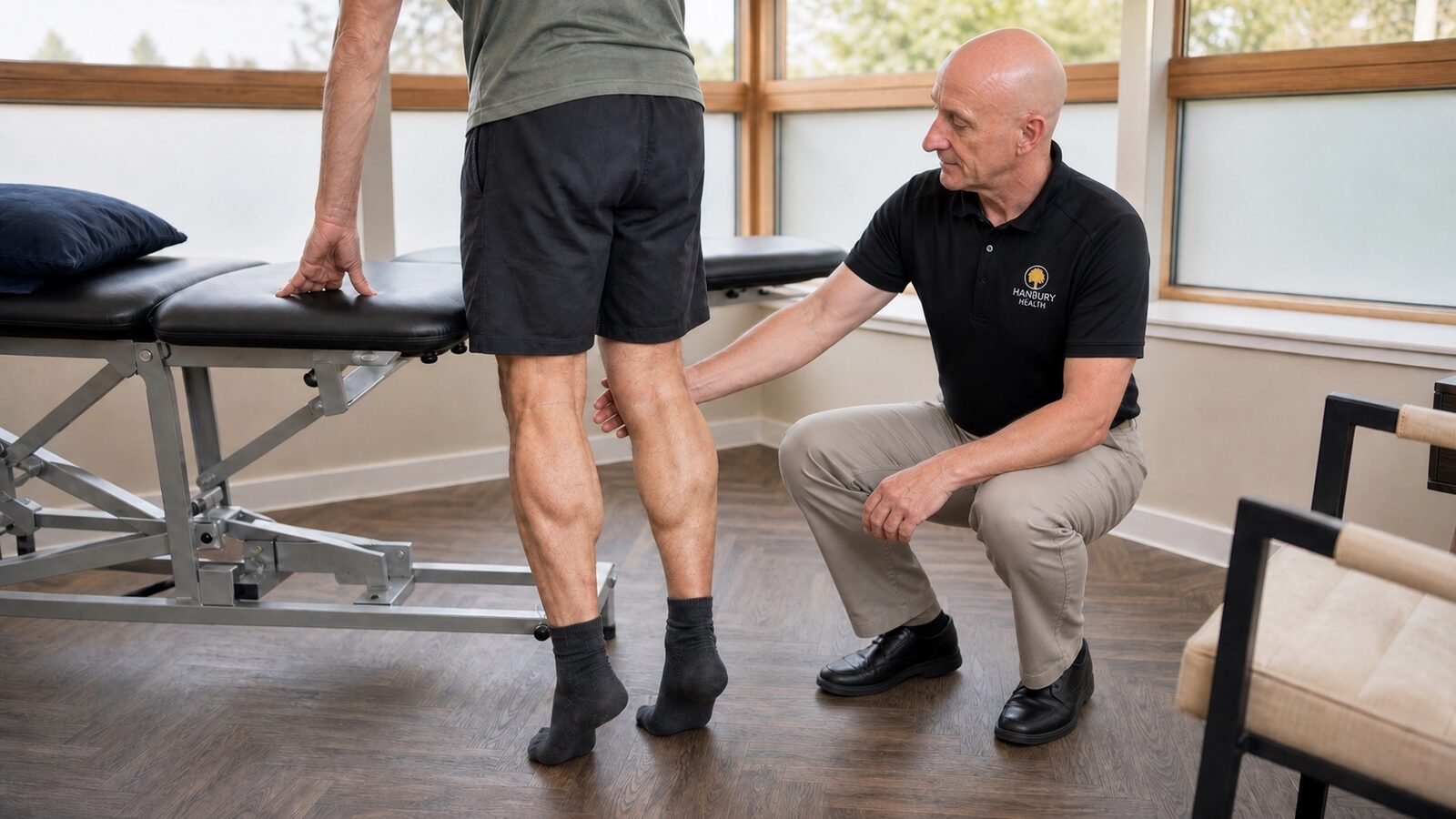
Achilles tendon rupture in Milton Keynes: recovery and rehabilitation
Recognising a rupture, the surgery-or-not decision, and the staged rehabilitation that largely determines the outcome.
Jones9 min readRead the article
Physiotherapy
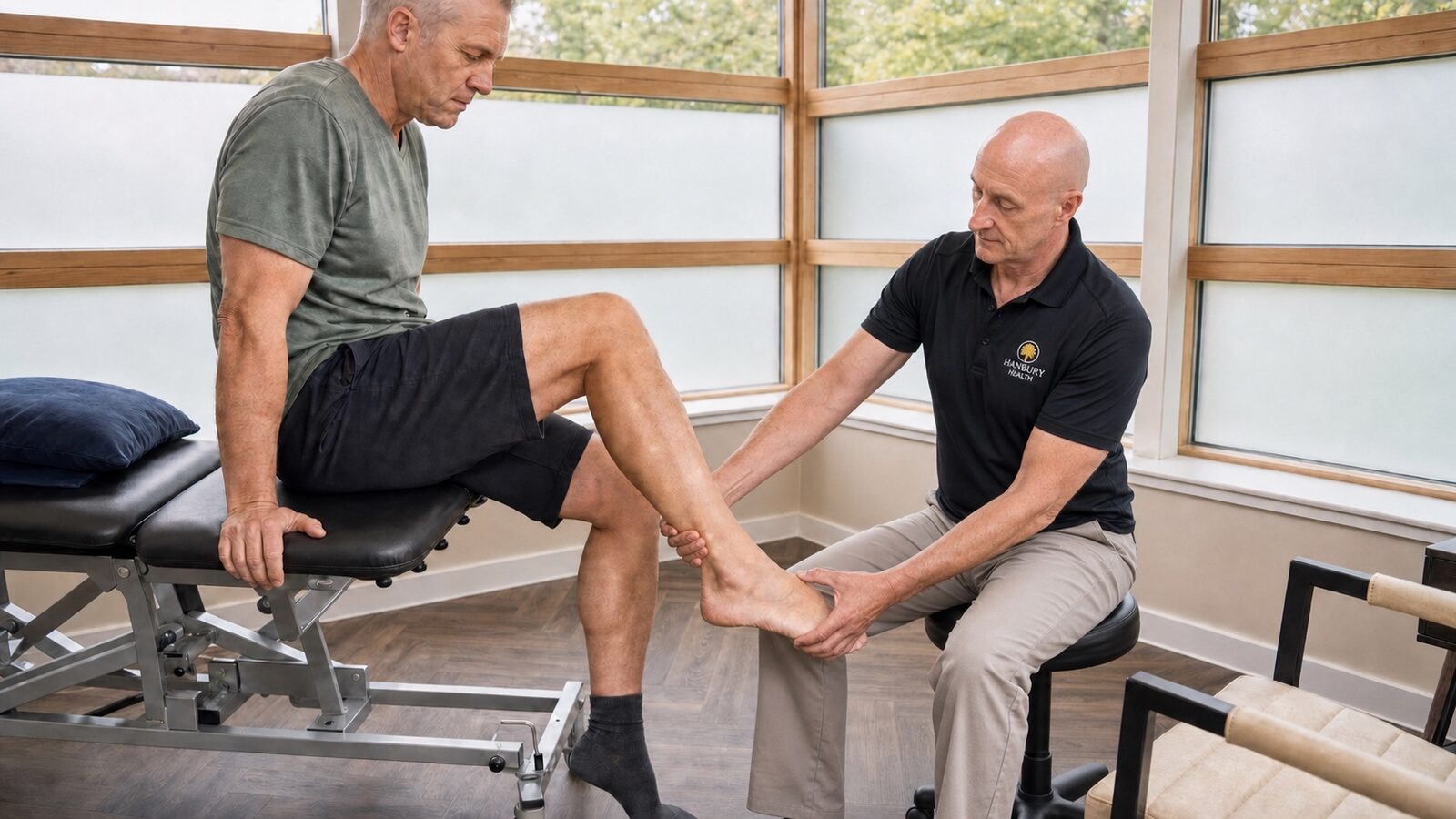
What causes Achilles tendinopathy, and why does loading beat rest?
What Achilles tendinopathy actually is, why rest alone rarely fixes it, and the loading programme that gives you the best chance of a full recovery.
Jones9 min readRead the article


Stay informed
More from the Hanbury team.
New articles on recovery, movement, physiotherapy and performance, sent when there's something worth reading. No spam, unsubscribe any time.