
Recovery · Treatments
Hyperbaric Oxygen with Hydrogen in Milton Keynes: Deep, Cellular Recovery, Honestly Explained
Written and medically reviewed by Prof Arul Ramasamy MA PhD MBA FRCS(Tr+Orth)
Consultant Orthopaedic Surgeon and Medical Director, Hanbury Health · Milton Keynes
Published:
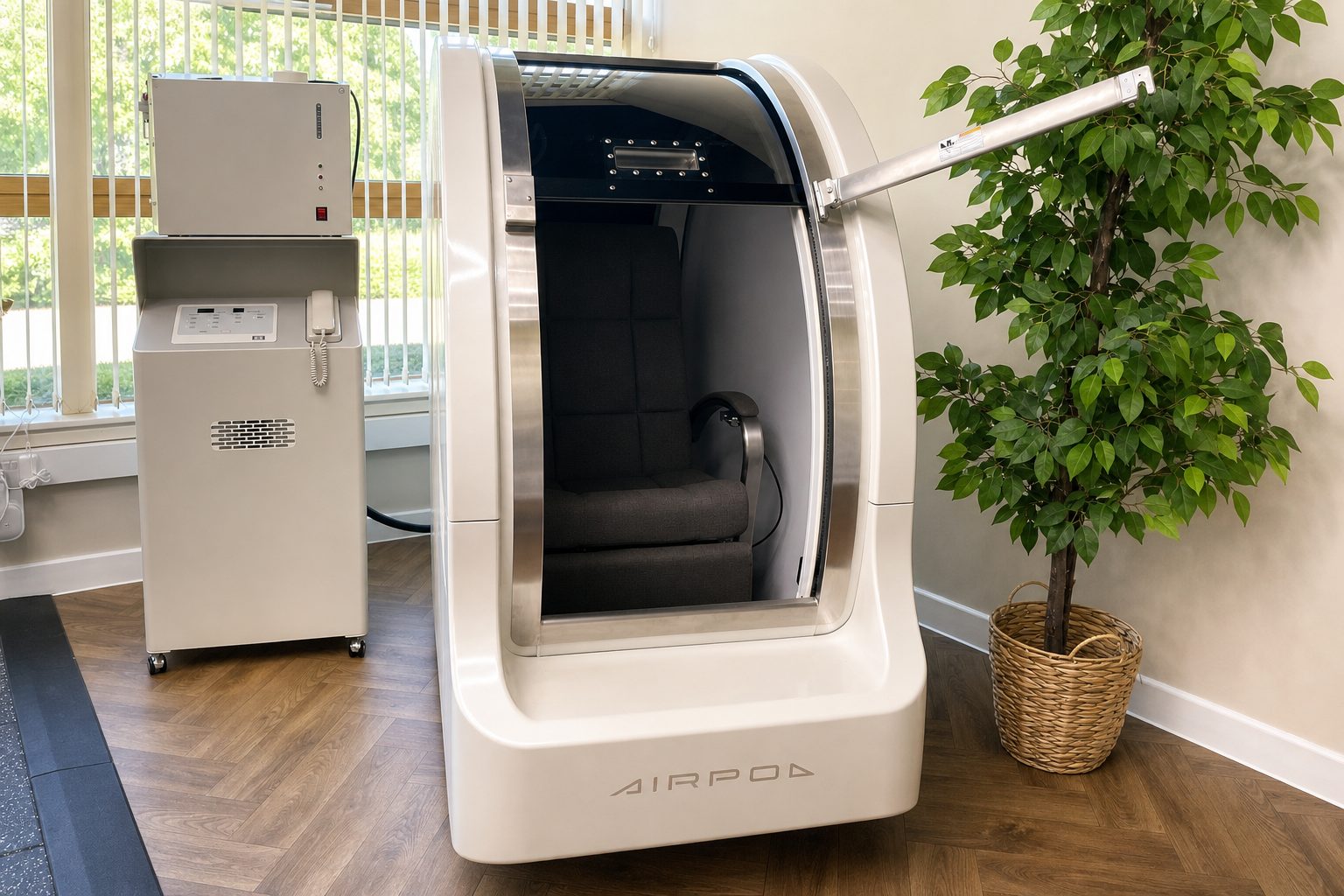
Oxygen is the fuel every cell in your body runs on. Hyperbaric therapy is simply a way to get more of it, dissolved deeper into the body, to support recovery and repair. At Hanbury Health we pair mild hyperbaric oxygen with molecular hydrogen, a gentle pressure session that leaves you rested and clear, and one of the quietest, most restful things in our recovery suite. It's also the newest and least-proven of our systems, and we'd rather tell you that plainly than oversell it. This article explains what it is, what the evidence does and doesn't support, and who it's for.
What it is
Mild hyperbaric oxygen therapy (mHBOT) is time spent resting inside a pressurised chamber, in our case, the AirPod. The chamber gently raises the pressure around you (mild hyperbaric means below 1.5 ATA, a fraction of the pressure change you'd feel scuba diving), which allows more oxygen to dissolve directly into your blood plasma rather than relying on red blood cells alone. The result is more oxygen carried further and deeper into the body's tissues, where it fuels the cellular processes behind energy and repair.
To that, we add molecular hydrogen, a small, well-tolerated gas being researched as a selective antioxidant. The idea is complementary: oxygen powers the cell's energy production; hydrogen helps mop up the most damaging by-products of that same metabolism.
Hyperbaric oxygen and hydrogen are used here as recovery and wellbeing tools. Nothing in this article has been evaluated by the MHRA or FDA, and it is not intended to diagnose, treat, cure or prevent any disease. We use them inside a clinically informed, supervised setting.
Mild hyperbaric is not medical HBOT, the honest distinction
This matters, because the internet blurs it constantly. Medical hyperbaric oxygen therapy is a hospital treatment delivered at high pressure (2.0 ATA and above) with near-100% oxygen, and it's an evidence-based medical therapy for a specific list of conditions, decompression sickness, certain non-healing wounds, carbon monoxide poisoning and others. That is a regulated medical treatment, and it is not what we offer.
What we offer is mild hyperbaric oxygen, a lower-pressure wellness session. Research is clear that the two are not the same thing: mild hyperbaric produces a smaller, gentler rise in oxygen without the risks (such as barotrauma) that come with high-pressure medical chambers. We use it for recovery and wellbeing, not to treat disease. If you have a medical condition that might benefit from true medical HBOT, that's a conversation for your doctor and a hospital hyperbaric unit. We'll always tell you so.
Why add hydrogen
Increasing oxygen metabolism has a catch: it can also generate reactive oxygen species, the unstable molecules behind oxidative stress. Molecular hydrogen is interesting precisely here. Unlike broad antioxidants, it appears to selectively neutralise the most harmful reactive species (such as the hydroxyl radical) while leaving the useful signalling ones alone. Pairing hydrogen with oxygen is therefore a logical combination: more fuel for repair, with a buffer against the oxidative cost of using it. The antioxidant and anti-inflammatory mechanisms are well described; the clinical applications are still being worked out.
Who it's for
Hyperbaric with hydrogen suits people who want the most passive, restorative end of recovery:
- Anyone recovering from hard training or a heavy schedule who wants deep, low-effort recovery.
- People chasing better energy and sleep, or who simply feel depleted.
- Those interested in the cellular and longevity side of wellbeing, oxygenation and oxidative stress.
- Anyone who wants an hour of genuine, screen-free rest as part of a broader recovery plan.
It's the most effortless session we offer: you lie back and breathe.
How it works
The physiology is straightforward. Normally your red blood cells are already almost fully loaded with oxygen, so simply breathing harder doesn't add much. Pressure changes that. By raising the ambient pressure, mild hyperbaric conditions push additional oxygen into solution in your blood plasma, a second delivery route that carries oxygen into areas and tissues that rely on diffusion. More available oxygen supports oxidative metabolism: the process cells use to produce energy (ATP), which underpins repair and recovery.
Hydrogen works alongside it as a small molecule that diffuses easily into cells and selectively buffers the most damaging oxidative by-products. Together, the rationale is more usable oxygen for repair, with hydrogen tempering the oxidative stress that heavier oxygen metabolism can create.
How hyperbaric oxygen with hydrogen supports cellular recovery
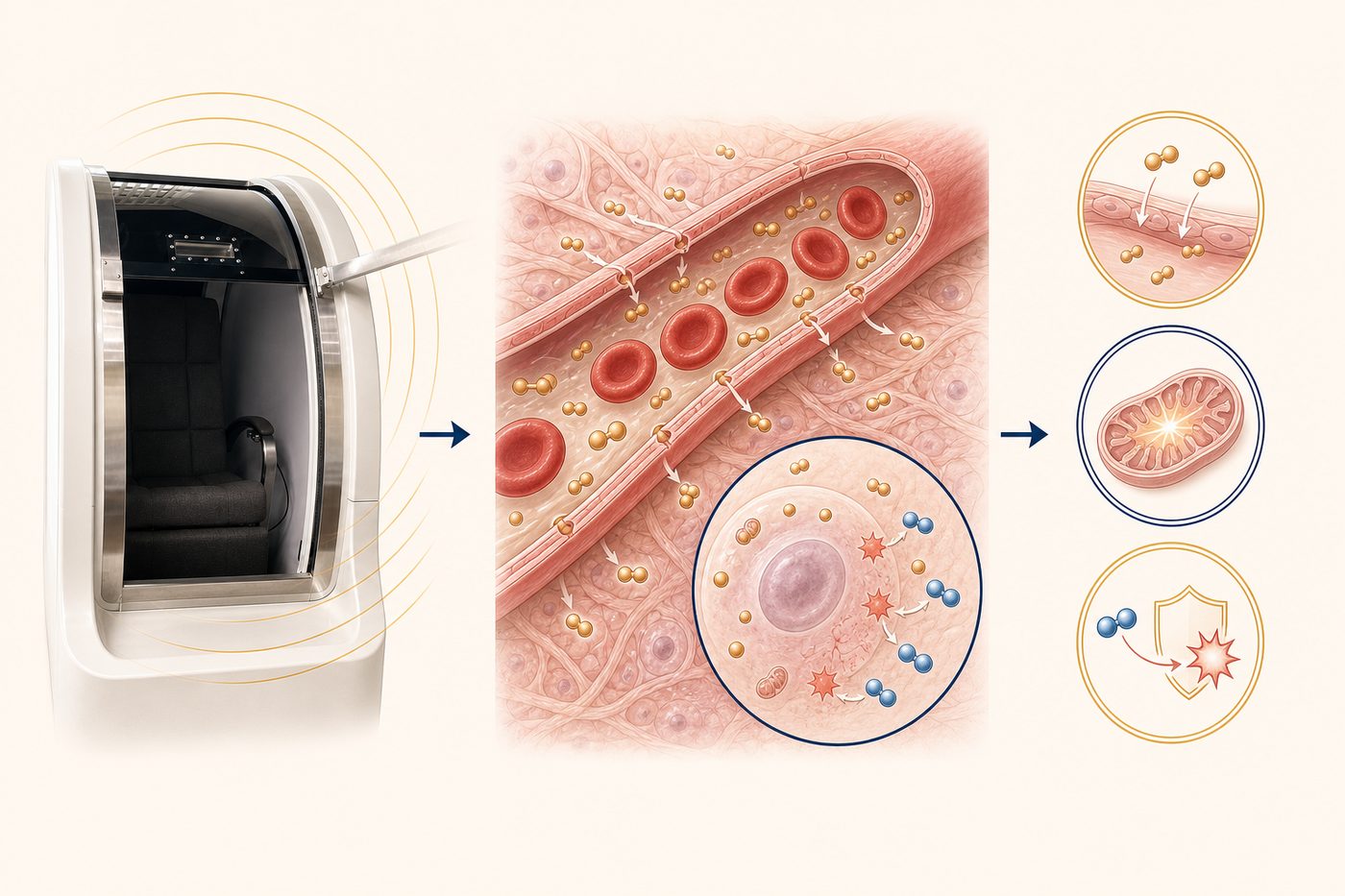
Gentle pressure rise, oxygen begins dissolving into the blood
Gold: oxygen diffusing into tissue. Blue: hydrogen buffering the oxidative by-products at the cell
- Oxygen dissolves into the blood, reaching deeper into tissue
- That extra oxygen fuels the cell's own energy production, driving repair
- Hydrogen selectively buffers the oxidative stress that comes with it
What the evidence shows
Here's the honest picture, and it's more cautious than the wellness industry usually admits.
For mild hyperbaric oxygen, studies show real but modest effects: improved oxygen availability in the blood, and signals around reduced fatigue and lower oxidative stress, generally without the risks of high-pressure chambers. These are early and small studies, and mild hyperbaric should not be confused with the much stronger evidence base for medical HBOT at hospital pressures.
For molecular hydrogen, the antioxidant and anti-inflammatory mechanisms are well supported, but the clinical evidence for specific health outcomes is still emerging, compelling in the lab, preliminary in people. We see it as a promising, well-tolerated addition, with no proven cure attached to it.
So we hold this one to the same standard as the rest of the suite, just more strictly: a plausible mechanism, encouraging early data, honest limits, and no disease claims. Most people simply find it deeply restful and come out feeling clearer and more energised. That is why we offer it.
For recovery and energy
Used as a recovery tool, the appeal is depth and passivity. Where cryotherapy and the ice shower jolt the system and compression works the legs, hyperbaric does the opposite, an hour of stillness while the body is given more of its most basic resource. Many people use it on a heavier recovery day, or pair it with the rest of the recovery suite across a visit, including Shiftwave and contrast therapy, as the restful counterpoint to the more intense tools.
For rest, sleep and everyday resilience
The most consistent thing people report is that they feel rested. An hour lying still in the chamber, breathing, with nothing to do and nowhere to be, is itself increasingly rare and valuable. Many find their sleep is better afterwards and their head clearer. For depleted, over-scheduled people, the enforced stillness is one of the benefits.
Where this fits into longevity and healthspan
The longevity interest in oxygen and hydrogen sits at the cellular level: oxygen drives the mitochondrial energy production that declines with age, and oxidative stress is one of the more established contributors to biological ageing. Tools that support oxygen delivery and buffer harmful oxidation are therefore an area of genuine research interest. It's an emerging field, and honesty demands we say so. We use hyperbaric alongside our HealthSpan Medicine and Performance Testing so that how you use it is informed by your own data. For hyperbaric specifically, that means adding it only when your own numbers and training load suggest deep, passive recovery is what's missing.
What a session is like here
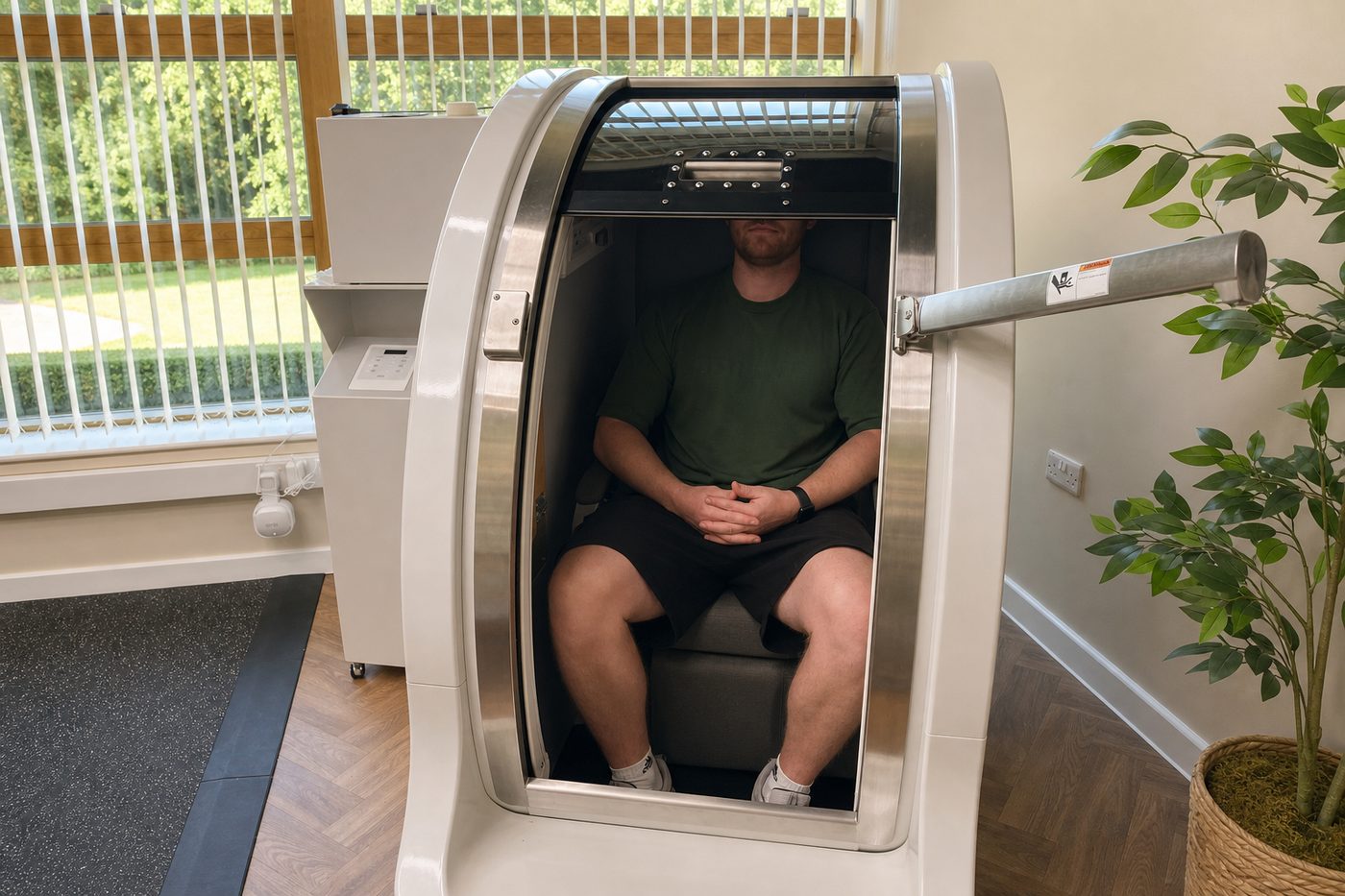
A session is genuinely restful. You settle into the AirPod chamber, the pressure rises gently, you may feel your ears adjust, much as on a plane, and we'll show you how to equalise easily, and then you simply relax and breathe for around an hour. Many people close their eyes, listen to something calming, or drift off. At the end, the pressure returns to normal slowly and you step out. There's no exertion involved; the work is done by the environment.
Who it's not for: safety and contraindications
Mild hyperbaric is well tolerated, but the pressure change means it isn't right for everyone. Speak to us or your own medical provider before a session if any of the following apply: a cold, blocked sinuses or a chest or ear infection; recent ear or sinus surgery, or a history of a collapsed lung (pneumothorax); significant lung disease such as severe COPD; uncontrolled epilepsy; pregnancy; severe claustrophobia; or a fever. We screen everyone before a first session, if you're unsure, ask, and we'll check.
Why we offer it, and where we draw the line
Oxygen delivery to tissue is something I think about a great deal as a surgeon: well-perfused, well-oxygenated tissue heals, and poorly oxygenated tissue doesn't. That fundamental, oxygen as the raw material of repair, is what makes mild hyperbaric worth offering as a recovery tool. But it's also the newest and least-proven system in our suite, and this is exactly the kind of area where wellness marketing runs ahead of the evidence. So we do two things: we offer a genuinely restful, well-tolerated session that people value, and we're rigorously honest about what it is and isn't, a wellness therapy, not medical HBOT, and not a treatment for any disease. If we ever think medical hyperbaric care is what someone actually needs, we'll say so and point them to it.
How to try hyperbaric with hydrogen in Milton Keynes
Hyperbaric oxygen with hydrogen is part of our wider recovery suite and the Recover pillar at Hanbury Health, available from £91. It works well on its own as a deep-rest session and pairs naturally with the rest of the suite in a single visit. Full pricing and membership options are on our recovery page.
Frequently asked questions
What is mild hyperbaric oxygen therapy?
Mild hyperbaric oxygen therapy (mHBOT) is resting in a gently pressurised chamber (below 1.5 ATA) so that more oxygen dissolves into your blood plasma and reaches deeper into tissue, supporting recovery and repair. At Hanbury we combine it with molecular hydrogen.
Is this the same as medical hyperbaric oxygen therapy (HBOT)?
No. Medical HBOT is a high-pressure hospital treatment for specific conditions such as decompression sickness and non-healing wounds. What we offer is mild, lower-pressure hyperbaric used as a wellness and recovery tool, not a medical treatment. If you have a condition that may need medical HBOT, speak to your doctor.
What does adding hydrogen do?
Molecular hydrogen is being researched as a selective antioxidant that may neutralise the most damaging reactive oxygen species and reduce inflammation. Paired with oxygen, the rationale is more fuel for repair with a buffer against oxidative stress. The mechanisms are well described; clinical outcomes are still emerging.
Does it actually work?
Mild hyperbaric shows real but modest effects on oxygen availability, fatigue and oxidative stress in early studies, and hydrogen has solid antioxidant mechanisms with preliminary clinical evidence. Most people find it deeply restful and come out feeling clearer and more energised. We don't make disease claims for it.
How long is a session and what does it feel like?
Around an hour of resting in the chamber. As the pressure rises you may feel your ears adjust, like on a plane; we'll show you how to equalise. Otherwise there's nothing to do but relax.
Is it safe? Who should avoid it?
It's well tolerated, but not for everyone. Anyone with a cold or blocked sinuses, a chest or ear infection, recent ear/sinus surgery, a history of collapsed lung, severe lung disease, uncontrolled epilepsy, severe claustrophobia, fever, or who is pregnant should consult a medical provider first. We screen everyone before a first session.
How much does hyperbaric oxygen with hydrogen cost in Milton Keynes?
It's part of our recovery suite, available from £91. Current pricing and membership options are on our recovery page.
Where can I try hyperbaric oxygen in Milton Keynes?
Mild hyperbaric oxygen with hydrogen is available at Hanbury Health in Milton Keynes, on its own or alongside the rest of our recovery suite. You can book through our website.
Book your recovery visit in Milton Keynes
To try hyperbaric oxygen with hydrogen, book a visit at Hanbury Health in Milton Keynes, a deep, restful session from £91, on its own or alongside the rest of our recovery suite.
Medical disclaimer: Mild hyperbaric oxygen and molecular hydrogen are used here as general wellbeing and recovery tools. They are not medical hyperbaric oxygen therapy (HBOT), and are not intended to diagnose, treat, cure or prevent any disease. The statements above have not been evaluated by the MHRA or FDA, and the evidence for these therapies is still developing. This article is for general information and is not medical advice. Always consult a qualified healthcare professional about your individual circumstances, particularly if you have any ear, sinus, lung, neurological or cardiovascular condition, or are pregnant.
Written by Prof Arul Ramasamy MA PhD MBA FRCS(Tr+Orth), Consultant Orthopaedic Surgeon and Medical Director, Hanbury Health, Milton Keynes.