
Physiotherapy
Do you need surgery, or can physiotherapy help? A Milton Keynes surgeon's answer

The short version
- For many common problems, good physiotherapy should be tried first, and often avoids surgery.
- Surgery is controlled trauma; it is worth it when clearly indicated, not as a default.
- High-quality trials show conservative care matches or beats surgery for several common conditions.
- Surgery is genuinely the right answer for specific problems, decided individually.
- The key is honest assessment of which camp your problem is in.
As a surgeon, my honest answer surprises some people: for a great many common musculoskeletal problems, well-delivered physiotherapy should come first, and often means surgery is not needed at all. Surgery is a powerful tool for the right problem. It is controlled trauma the body then has to recover from, so it is reserved for cases where it clearly helps rather than used as a default. For a lot of the conditions people assume need an operation, the evidence shows that good, progressive rehabilitation does as well or better, with less risk. Knowing which situation you are in is the whole question, and it deserves an honest answer.
Why "physio first" is often the right sequence
Good outcomes come from good foundations, and for musculoskeletal problems those foundations are strength, movement and load tolerance, which physiotherapy builds. Because surgery inevitably involves trauma, recovery and risk, the sensible default for many conditions is to see whether restoring strength and function resolves the problem before considering an operation. For a large proportion of people, it does. This is about using surgery where it adds value and avoiding it where it does not.
What the evidence shows
The evidence here is stronger, and more surprising, than many expect. For common subacromial shoulder pain, a major placebo-controlled trial found keyhole decompression surgery gave no clinically important benefit over non-surgical care. For gluteal tendinopathy (lateral hip pain), education and exercise outperformed injections. For many degenerative meniscal knee problems and much low back pain, guidelines and trials support exercise-based management ahead of surgery. Across these very common problems, the pattern is consistent: good rehabilitation is not a second-best holding measure, it is frequently the treatment of choice.
When surgery is the right answer
None of this is anti-surgery, and it would be dishonest to pretend physiotherapy fixes everything. Some problems genuinely need an operation: significant traumatic tears, certain fractures and unstable injuries, advanced arthritis that has exhausted conservative care, nerve compression causing progressive weakness, and others. In these cases, delaying appropriate surgery helps no one. The skill is in telling the two situations apart, and in preparing you well if you do need surgery, because going in stronger, with prehabilitation, improves recovery.
Why Hanbury Health is different
This question, surgery or not, is exactly what Hanbury is built to answer honestly, because we have both sides under one roof. Rehabilitation is overseen by me as a practising surgeon, and we work closely with local orthopaedic colleagues, so you get a straight answer about whether your problem needs an operation or, far more often, a well-run rehabilitation programme, without the incentive to push you toward either. If you need surgery, we prepare you for it and rehabilitate you afterwards on one continuous pathway; if you do not, we get on with the treatment that will actually help. The goal is capability, and avoiding unnecessary surgery. See how our physiotherapy service in Milton Keynes is set up, or read our companion pieces on rotator cuff shoulder pain and what is prehabilitation before surgery .
Frequently asked questions
Can physiotherapy help me avoid surgery?
For many common musculoskeletal problems, yes. Good rehabilitation resolves or substantially improves a large proportion of cases, and for several conditions the evidence shows it matches or beats surgery.
Which conditions are usually treated without surgery first?
Many, including common subacromial shoulder pain, gluteal tendinopathy, much low back pain and sciatica, and many degenerative meniscal knee problems, are managed with exercise-based care first.
When do I actually need surgery?
For specific problems: significant traumatic tears, certain fractures and unstable injuries, advanced arthritis after conservative care, and nerve compression causing progressive weakness, among others, decided individually.
Is it bad to delay surgery to try physiotherapy?
For most non-urgent problems, trying good rehabilitation first is sensible and low-risk. For the specific problems that need surgery, it should not be delayed, which is why honest assessment matters.
Where can I get an honest opinion in Milton Keynes?
Hanbury Health in Milton Keynes offers surgeon-overseen assessment and rehabilitation, with a consultant-integrated pathway, so the surgery-or-not question is answered honestly.
References
Not sure if you need surgery or physiotherapy?
Hanbury Health is the only place in Milton Keynes where physiotherapy is overseen by a foot-and-ankle surgeon, with on-site diagnostic ultrasound and a surgeon-led pathway if you ever need more than physiotherapy.
About the author: Simon Jones is a director of Hanbury Health and a Chartered Physiotherapist (MPhil, BSc (Hons), MCSP, HCPC-registered), with a particular interest in clinical diagnostics including diagnostic ultrasound. Rehabilitation across the physiotherapy service is medically reviewed by Prof Arul Ramasamy, a consultant orthopaedic surgeon.
General information, not medical advice. Written by Simon Jones. Medically reviewed by Prof Arul Ramasamy MA PhD MBA FRCS(Tr+Orth). Last reviewed: 25 July 2026.
Related insights

Physiotherapy
How do you know you're ready to return to sport after injury?
Why a calendar date is the wrong marker, what strength, movement and psychological testing actually shows, and how the gap between pain-free and match-fit gets closed.
Allen9 min readRead the article
Physiotherapy
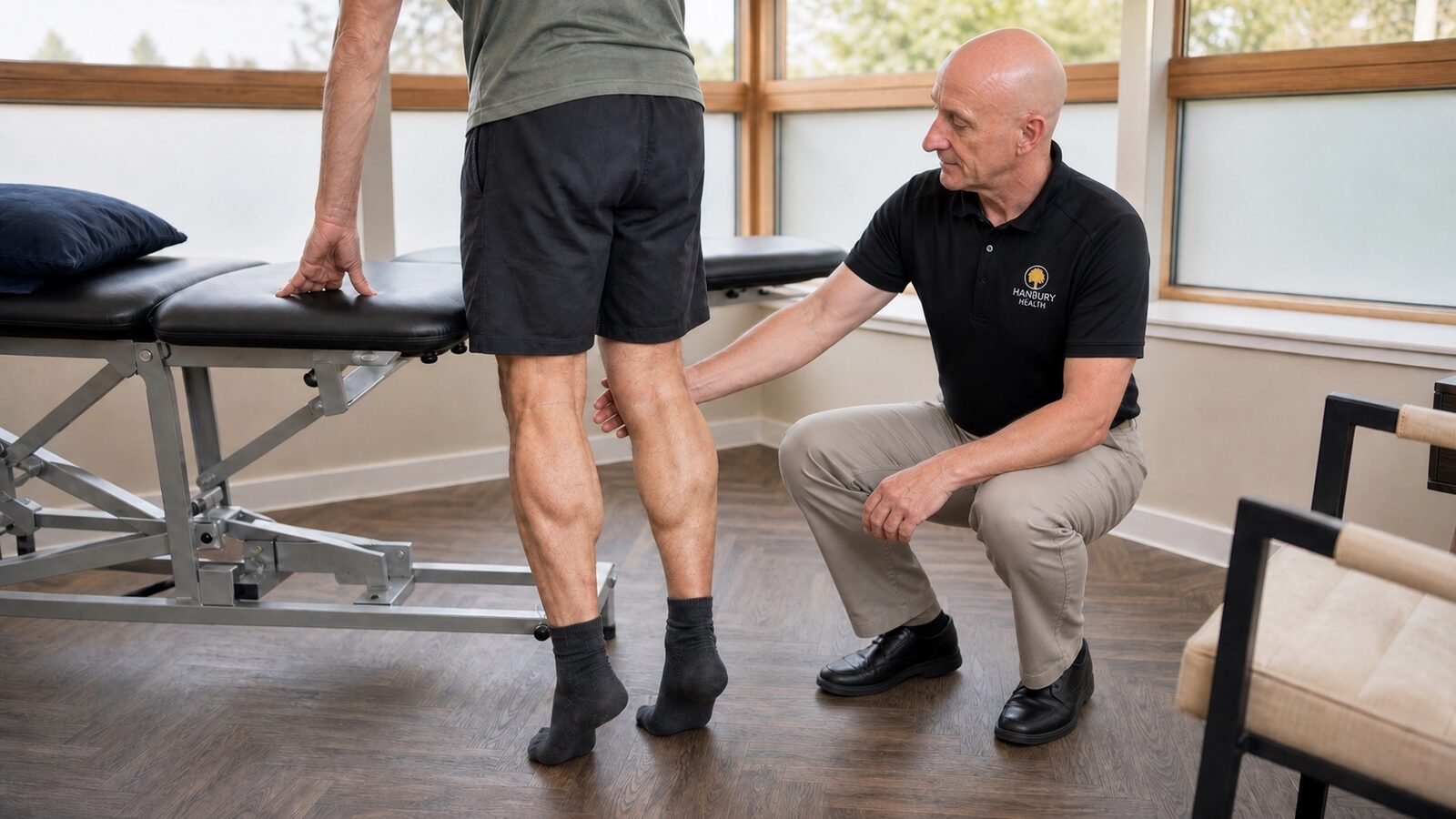
Achilles tendon rupture in Milton Keynes: recovery and rehabilitation
Recognising a rupture, the surgery-or-not decision, and the staged rehabilitation that largely determines the outcome.
Jones9 min readRead the article
Physiotherapy
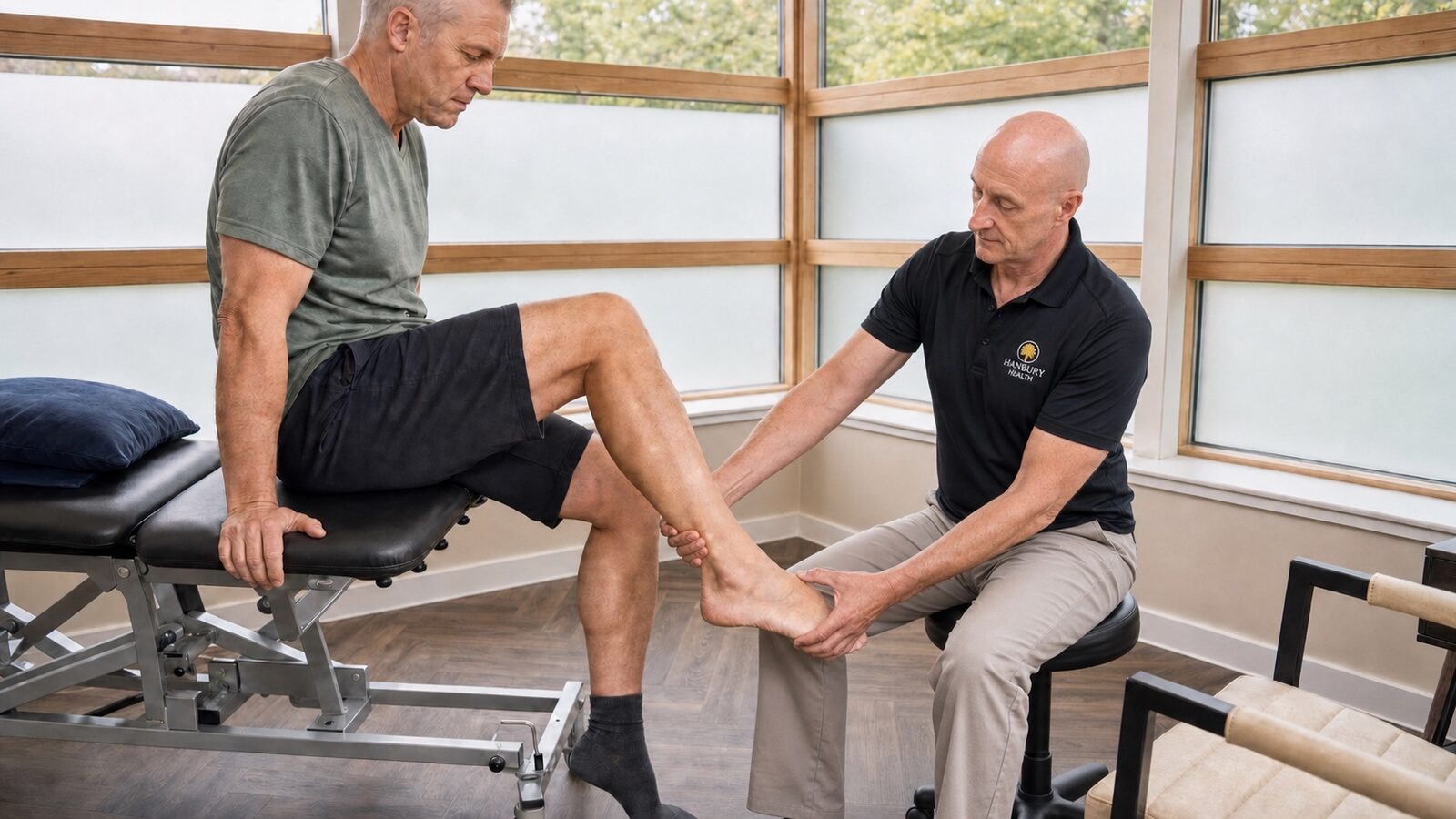
What causes Achilles tendinopathy, and why does loading beat rest?
What Achilles tendinopathy actually is, why rest alone rarely fixes it, and the loading programme that gives you the best chance of a full recovery.
Jones9 min readRead the article


Stay informed
More from the Hanbury team.
New articles on recovery, movement, physiotherapy and performance, sent when there's something worth reading. No spam, unsubscribe any time.