
Physiotherapy
Rotator cuff pain: what helps, and do you need surgery?

The short version
- Most rotator cuff pain is caused by tendon overload and weakness, not by a tear that needs surgery.
- For the majority of people, a well-structured strengthening programme is as effective as surgery, even when a small tear is present on a scan.
- The evidence is clear: physiotherapy should be the first line of treatment for almost all non-traumatic rotator cuff pain.
- Surgery is considered for large or full-thickness tears in younger, active people, or when a fair trial of rehab has not moved things forward.
- Most people improve meaningfully within 12 weeks of guided strengthening. Full recovery often takes 3 to 6 months.
Rotator cuff pain is one of the most common reasons people come to physiotherapy. The good news is that for most people it responds well to a structured strengthening programme, and even when a tear is present on a scan, surgery is rarely the first, or best, answer. High-quality trials have shown that well-guided physiotherapy produces similar long-term outcomes to surgery for the majority of non-traumatic cases. That is why guidelines now recommend rehab as the first line of treatment for almost all non-acute shoulder pain.
What is the rotator cuff, and what goes wrong?
The rotator cuff is a group of four small muscles and their tendons that wrap around the shoulder, keep the head of the upper arm centred in the socket, and control almost every movement you make with your arm. Pain from the rotator cuff typically sits at the outside or front of the shoulder, spreads down the arm, and is worst reaching overhead, behind your back or lying on the affected side.
Most rotator cuff problems are not sudden tears. They are overload problems in the tendons, often with weakness and loss of control that has built up over time. Small degenerative tears are common with age and are frequently painless.
How is it diagnosed?
A physiotherapist will take a careful history, test the rotator cuff and surrounding shoulder muscles, check movement and control, and rule out the other things that can cause shoulder pain, including frozen shoulder, arthritis of the AC joint, and referred pain from the neck. Imaging is not routine. Scans often show changes in shoulders that are pain-free, so an MRI or ultrasound is most useful when a specific decision depends on it.
Do you need surgery?
In most non-traumatic cases, no. The Finnish trial by Kukkonen and colleagues showed no meaningful difference between surgery and physiotherapy for atraumatic supraspinatus tears at two years. The UK CSAW trial found that subacromial decompression surgery was no better than a placebo procedure. The current consensus, which our team follows, is that a fair trial of well-guided physiotherapy should come first for almost all non-acute shoulder pain. Surgery is considered for large, symptomatic, full-thickness tears in younger, active people, or when a well-run rehab programme has not moved things forward.
How is it treated?
The most effective treatment is progressive strengthening of the rotator cuff and the whole shoulder complex, including the scapular stabilisers and the surrounding trunk. Programmes typically start with isometric holds and low-range strength work if the shoulder is very irritable, then progress through resisted rotation, pulling and pressing work over 8 to 12 weeks. Around that, we address the neck if it is contributing, restore full range where that has been lost, and rebuild sport, gym or work-specific tasks. A steroid injection is considered when pain is preventing rehab.
What does recovery look like?
Most people notice a real change within 8 to 12 weeks of guided strengthening, and a return to sport, gym work or manual jobs within 3 to 6 months. Recovery is rarely linear. Flare-ups during the process are usually a sign to adjust load, not to stop.
When should you see a physiotherapist?
Shoulder pain that has been present for more than a couple of weeks, or that is waking you at night or limiting normal activity, deserves a proper assessment. Our physiotherapy team in Milton Keynes will diagnose what is going on, build the right programme for the stage you are at, and know when a surgical opinion is genuinely warranted. If your shoulder is stiff and losing range as well as painful, see our companion piece on frozen shoulder. For treatment in Milton Keynes, see our shoulder pain physiotherapy page.
Frequently asked questions
Do I need surgery for a rotator cuff tear?
In most non-traumatic cases, no. High-quality trials have shown that structured physiotherapy produces similar outcomes to surgery for degenerative tears, and is now recommended as the first line of treatment. Surgery is considered for large, symptomatic, full-thickness tears in younger, active people, or when well-guided rehab has not moved things forward.
Do I need an MRI or an ultrasound?
Not straight away. Scans often show changes in shoulders that are completely pain-free, so imaging without a good clinical picture can be misleading. A scan is genuinely useful when a specific decision depends on it, for example whether to consider surgery or an injection.
What about a cortisone injection?
A well-placed steroid injection can reduce pain enough to let rehab progress. It is not a cure, and repeated injections into the same tendon are not recommended. Used selectively alongside a strengthening programme, it can be very helpful.
How long will recovery take?
Most people notice meaningful change within 8 to 12 weeks of well-guided rehab. Full recovery, including a return to sport, gym work or manual jobs, typically takes 3 to 6 months.
Why is the pain worst at night?
Night pain is common with rotator cuff problems. Lying on the affected side compresses the tendon, and reduced movement means the shoulder stiffens. Sleeping with a pillow supporting the arm, and rehab that builds tolerance to compression positions, both help.
References
- Kukkonen J, Joukainen A, Lehtinen J, et al. Treatment of nontraumatic rotator cuff tears: a randomised controlled trial with two years of clinical and imaging follow-up. Journal of Bone and Joint Surgery, 2015.
- Beard DJ, Rees JL, Cook JA, et al. Arthroscopic subacromial decompression for subacromial shoulder pain (CSAW): a multicentre, pragmatic, parallel group, placebo-controlled, three-group, randomised surgical trial. The Lancet, 2018.
- Littlewood C, Bateman M, Brown K, et al. A self-managed single exercise programme versus usual physiotherapy for chronic rotator cuff disorders. Clinical Rehabilitation, 2016.
- NICE Clinical Knowledge Summaries. Shoulder pain. National Institute for Health and Care Excellence.
Not sure if you need surgery or physiotherapy?
Hanbury Health's physiotherapy is built on Physix, the Milton Keynes practice established in 1998 and now part of Hanbury Health, a chartered team with three decades of elite sport, diagnostic ultrasound and evidence-led rehab.
About the author: Simon Jones is a director of Hanbury Health and a Chartered Physiotherapist (MPhil, BSc (Hons), MCSP, HCPC-registered), with a particular interest in clinical diagnostics including diagnostic ultrasound. Rehabilitation across the physiotherapy service is medically reviewed by Prof Arul Ramasamy, a consultant orthopaedic surgeon.
General information, not medical advice. Written by Simon Jones. Medically reviewed by Prof Arul Ramasamy MA PhD MBA FRCS(Tr+Orth). Last reviewed: 25 July 2026.
Related insights

Physiotherapy
How do you know you're ready to return to sport after injury?
Why a calendar date is the wrong marker, what strength, movement and psychological testing actually shows, and how the gap between pain-free and match-fit gets closed.
Allen9 min readRead the article
Physiotherapy
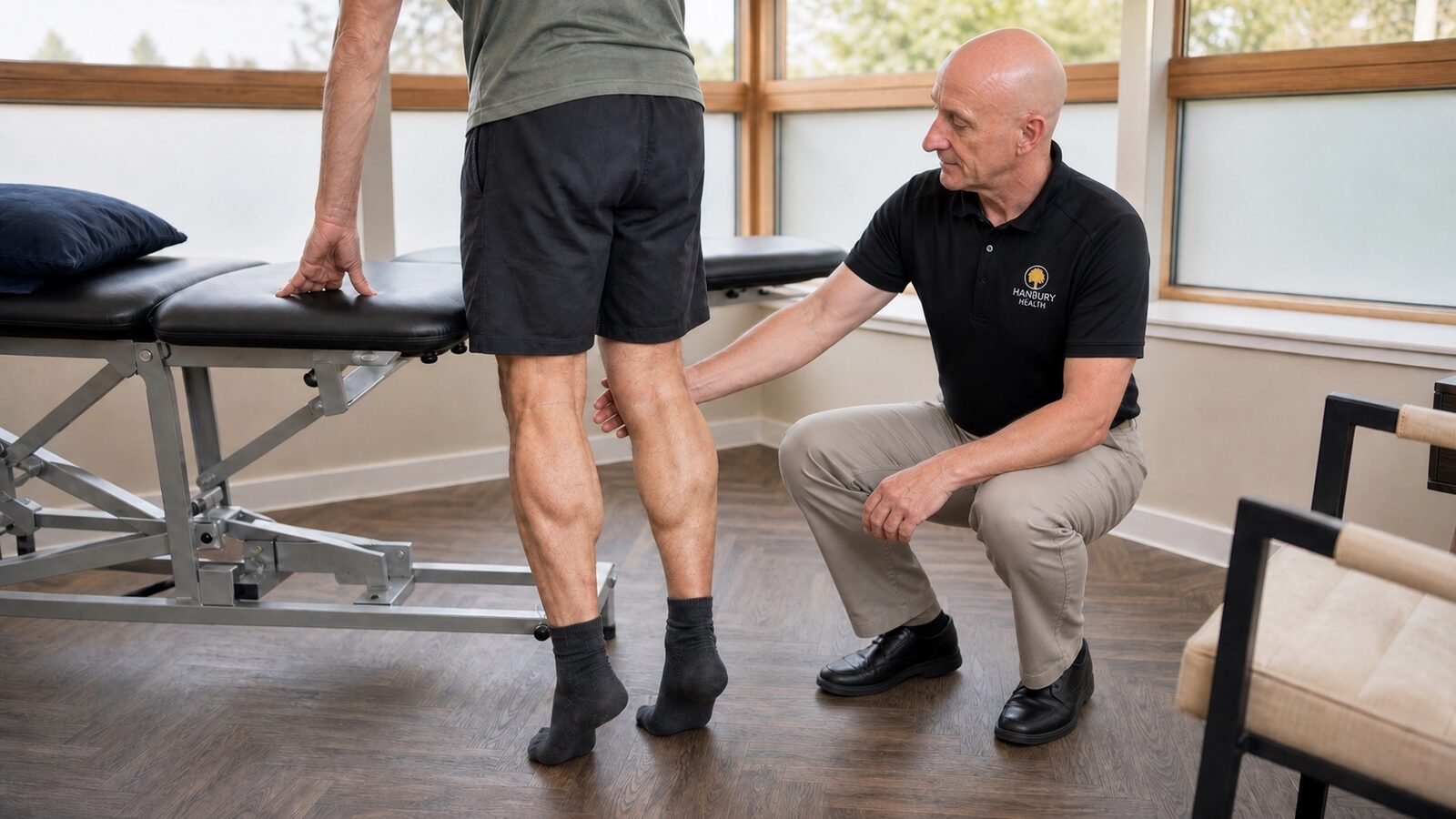
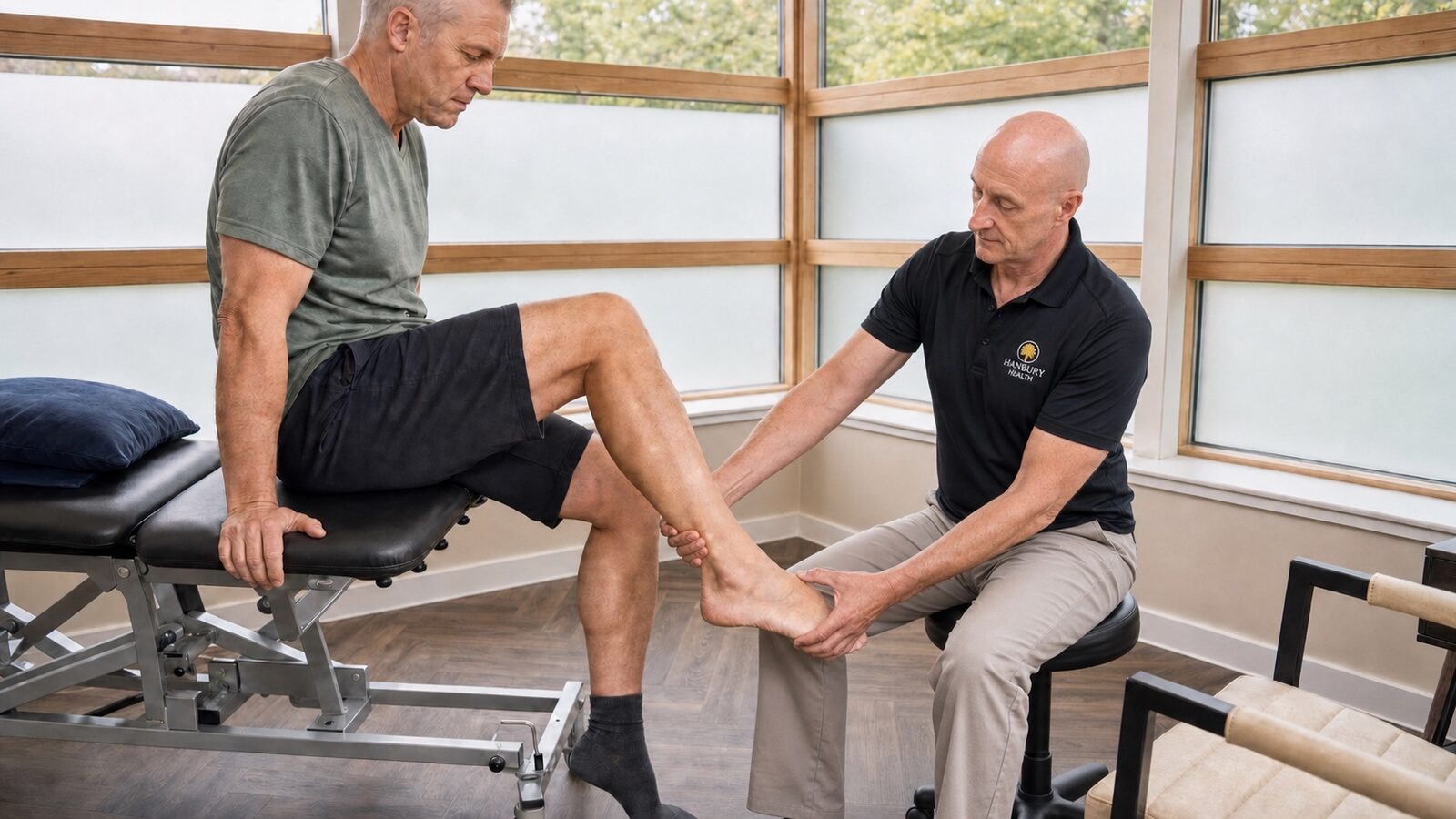
Achilles tendon rupture in Milton Keynes: recovery and rehabilitation
Recognising a rupture, the surgery-or-not decision, and the staged rehabilitation that largely determines the outcome.
Jones9 min readRead the article
Physiotherapy
What causes Achilles tendinopathy, and why does loading beat rest?
What Achilles tendinopathy actually is, why rest alone rarely fixes it, and the loading programme that gives you the best chance of a full recovery.
Jones9 min readRead the article


Stay informed
More from the Hanbury team.
New articles on recovery, movement, physiotherapy and performance, sent when there's something worth reading. No spam, unsubscribe any time.