
Recovery · Treatments
The Medical-Grade Red Light Bed in Milton Keynes: Full-Body Light Therapy for Skin, Recovery and Pain
Written and medically reviewed by Prof Arul Ramasamy MA PhD MBA FRCS(Tr+Orth)
Consultant Orthopaedic Surgeon and Medical Director, Hanbury Health · Milton Keynes
Published:
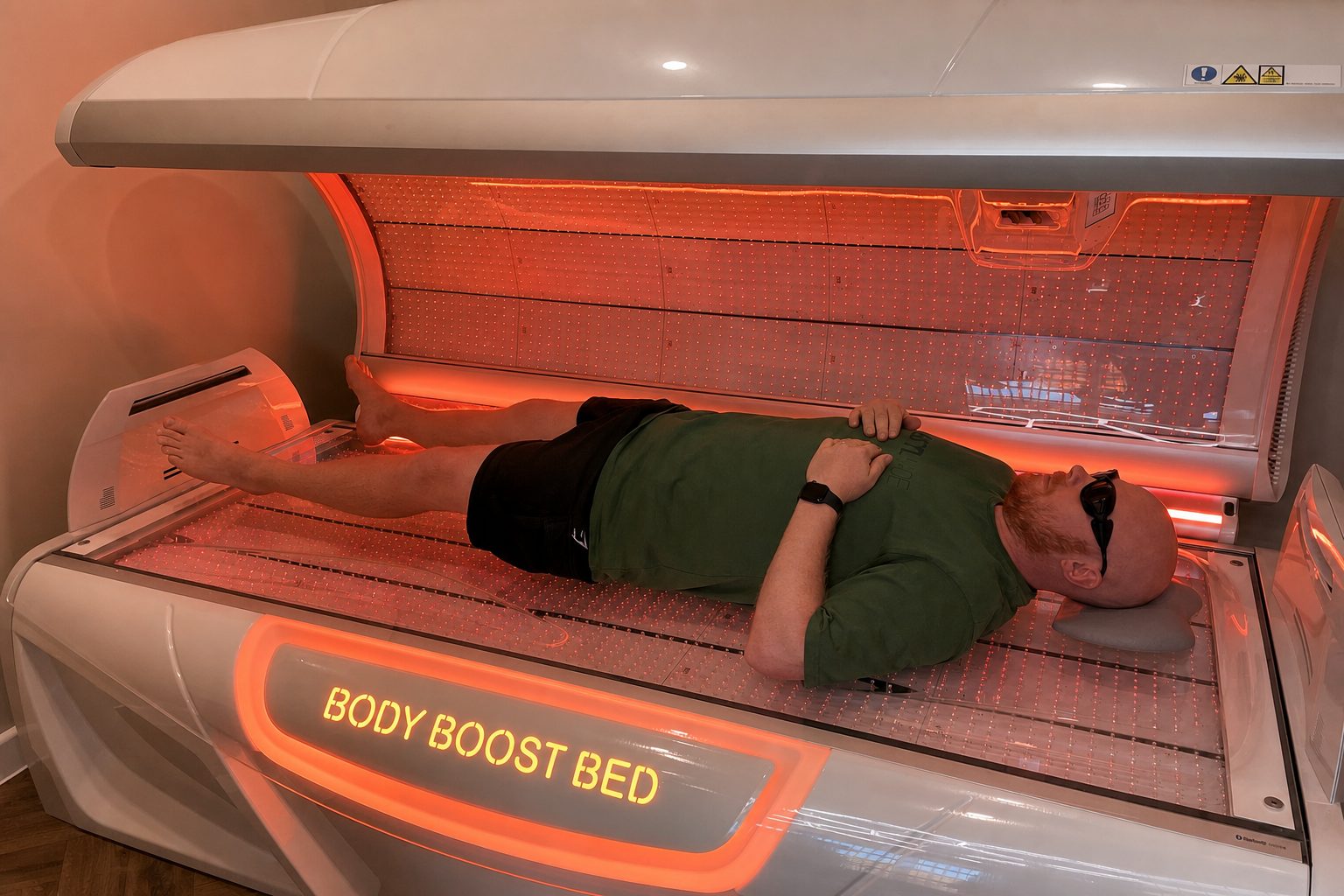
Certain wavelengths of light do something measurable inside your cells. That's the basis of photobiomodulation, and it's why red light therapy has moved from elite sports clinics into mainstream recovery. At Hanbury Health we use a full-body, medical-grade (CE-marked) red light bed that treats your whole body at once, for skin, recovery and pain in a single, effortless session. It's one of the better-evidenced tools in our recovery suite, and among the most versatile. This article explains what it does, what the science supports, and who it's for.
What the red light bed is
The Body Boost Bed is a full-body light-therapy bed. You lie on it, and a high-density array of LEDs bathes your whole body in specific wavelengths of light, no heat, no UV, nothing to feel beyond the glow. The mechanism is photobiomodulation: light at the right wavelengths is absorbed by your cells and gently stimulates them to produce more energy.
Two things make it worth singling out. First, it's a CE-marked medical device, built to defined safety and quality standards. Second, it treats the entire body at once. Unlike a handheld panel you'd hold against one area, a full-body bed delivers a consistent dose head to toe in a single session.
Red light therapy is used here as a recovery, skin and wellbeing tool. Nothing in this article has been evaluated by the MHRA or FDA in the way a prescription treatment would be, and it is not intended to diagnose, treat, cure or prevent any disease. We use it inside a clinically informed setting.
The three wavelengths and what they do
Different wavelengths reach different depths, which is why the bed combines three:
- Blue (~470nm) stays at the surface of the skin and is used mainly for skin clarity.
- Red (~630–660nm) penetrates into the skin and is the most studied range for collagen, complexion and surface tissue.
- Near-infrared (~850–940nm) reaches deepest, into muscle, joints and connective tissue, which is why it's the range associated with recovery and pain.
Using them together is the point: one session works on the skin and the deeper tissue at the same time.
The three wavelengths, and how each one works
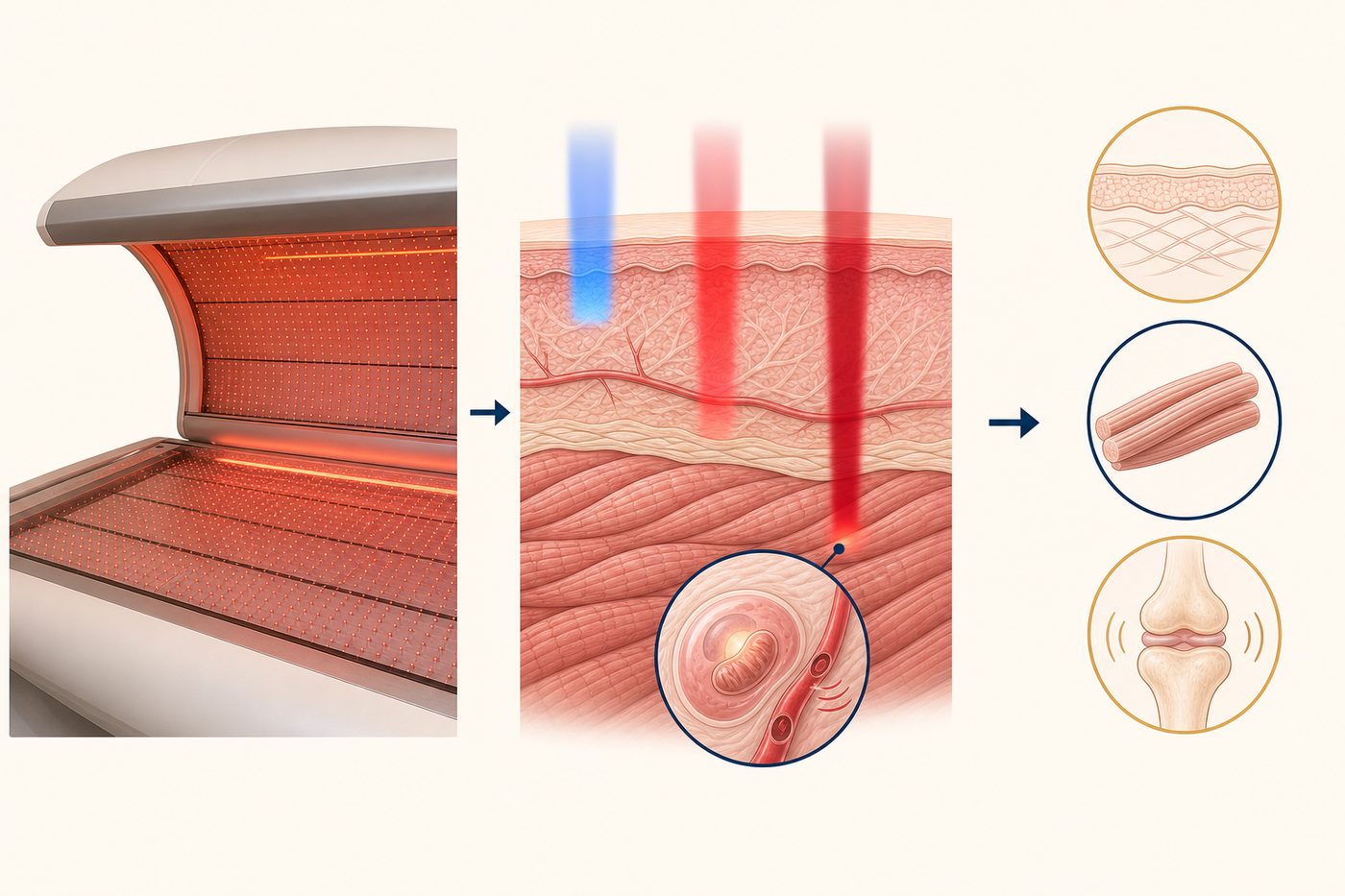
Blue, red and near-infrared light delivered across the whole body
Each wavelength reaches a different depth, blue to the skin's surface, red into the dermis, near-infrared down into muscle, where it fuels the cell's mitochondria
- Skin, supports collagen, firmness and complexion
- Muscle, faster recovery, less soreness
- Joints, eases pain and inflammation
Who it's for
Red light suits an unusually broad range of people, because it does several different jobs well:
- Anyone focused on skin and ageing, collagen, complexion, firmness.
- Athletes and trainers wanting faster muscle recovery and less soreness.
- People managing everyday aches, stiffness or inflammation.
- Anyone who wants a completely effortless, heat-free session, you simply lie down.
You don't need a specific problem to benefit. It's the most accessible entry point in the suite, and one of the few that appeals as much for how you look as how you recover.
How it works
The science is genuinely cellular. Inside your cells, the mitochondria are the structures that produce energy. Red and near-infrared light is absorbed by an enzyme in the mitochondria (cytochrome c oxidase), which nudges them to produce more ATP, the molecule that powers virtually every repair process in the body. Alongside this, the light prompts a release of nitric oxide, which relaxes blood vessels and supports circulation, and it modulates inflammatory signalling.
More cellular energy, better local circulation, and calmer inflammation, delivered without heat, needles or downtime. That combination is why the same technology shows up in dermatology, physiotherapy and sports recovery.
What the evidence shows
This is one of the areas where the science is relatively strong, though, as always, it depends what you're asking of it.
For muscle recovery, a 2017 meta-analysis found red light therapy reduced delayed-onset muscle soreness by an average of around 43% compared with placebo. For skin, controlled studies (including a well-known 2014 trial using red and near-infrared light) have shown measurable improvements in collagen density, elasticity and complexion over several weeks. For pain and inflammation, reviews report that photobiomodulation can meaningfully reduce pain in a range of acute and chronic conditions. There's even an umbrella review of randomised trials pointing to benefits across multiple outcomes.
The honest caveats: dose and wavelength matter a lot, individual responses vary, and skin and recovery results build over repeated sessions rather than appearing after one. Of the passive tools we offer, red light is among the best supported, and the mechanism is well understood.
For recovery
Used after training, near-infrared light reaches into muscle and connective tissue to support the cellular repair that recovery depends on, and the evidence for reduced soreness is some of the clearest in the recovery field. It pairs naturally with the rest of the suite, many people use it in the same visit as cryotherapy, compression, contrast therapy, hyperbaric oxygen or Shiftwave, and, being heat-free and effortless, it's an easy one to use often.
For skin and anti-ageing
This is where the red light bed does something none of our other systems do. Red light is one of the most established non-invasive tools for skin: by stimulating fibroblasts and supporting collagen and elastin production, regular sessions are associated with firmer, smoother skin and improved complexion over time. It's why red light has become a fixture in dermatology and aesthetics. For anyone thinking about how they age as well as how they recover, it's a genuinely evidence-backed, needle-free option.
How red light supports collagen and skin quality
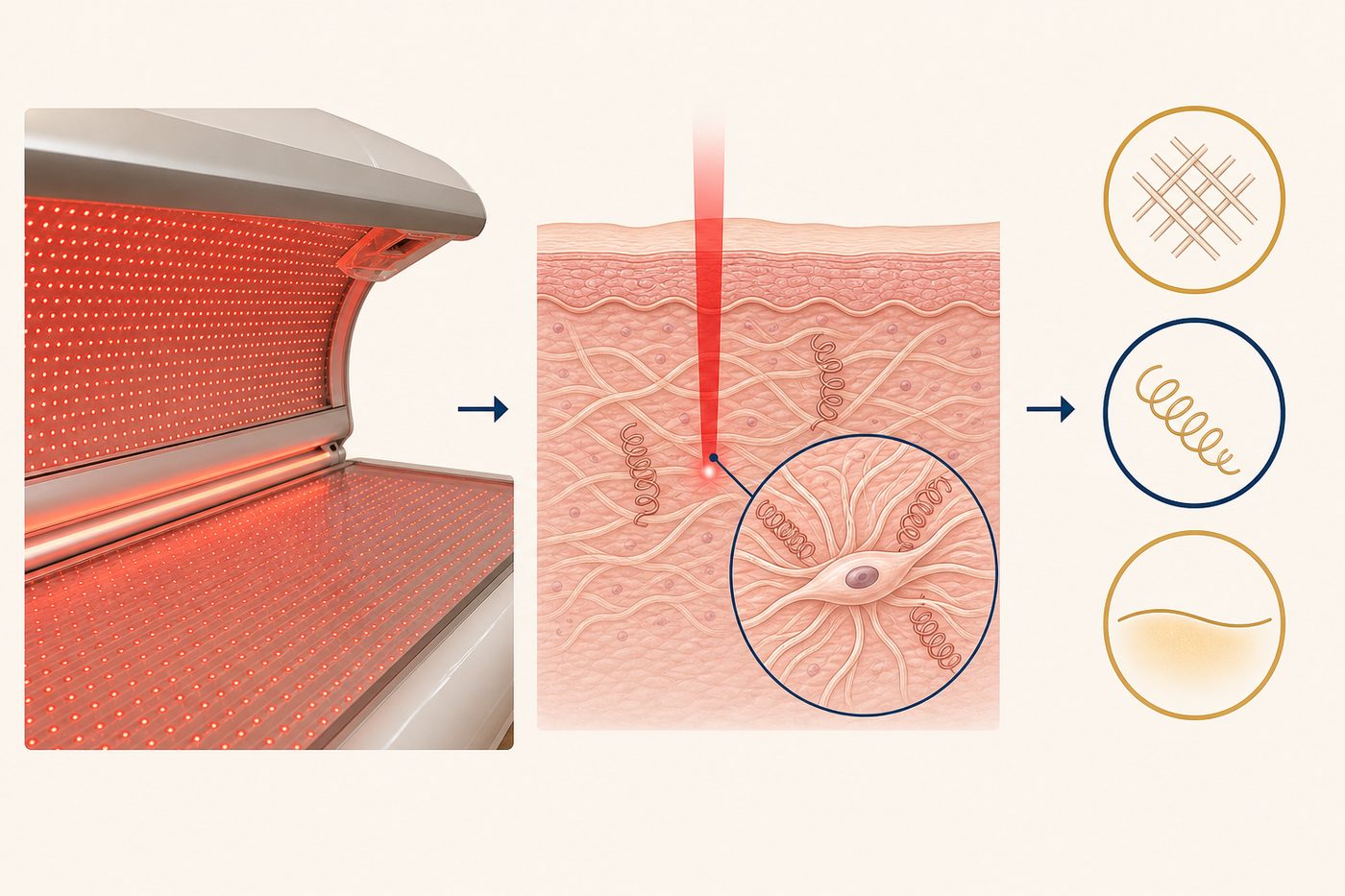
Red light delivered across the whole body
Red light reaches the dermis and stimulates fibroblasts, the cells that produce new collagen
- Builds a denser, stronger collagen matrix
- Stimulates fibroblasts to produce new collagen
- Supports firmer, smoother, more radiant skin
For pain and inflammation
Because near-infrared light penetrates to joints and deeper tissue and modulates inflammatory pathways, photobiomodulation has a solid track record for easing musculoskeletal aches and stiffness. As an orthopaedic surgeon, this is the application I find most clinically credible: it's used in physiotherapy for exactly these reasons. It isn't a substitute for proper assessment and treatment of an injury, but as a supportive tool for everyday aches and recovery, it earns its place.
Where this fits into longevity and healthspan
The healthspan interest in red light runs on two tracks. The first is skin: skin ageing is one of the most visible markers of biological ageing, and light therapy is a rare non-invasive way to support collagen and skin quality over time. The second is cellular: mitochondrial function declines with age, and a tool that supports mitochondrial energy production is of genuine interest for how well cells, and therefore tissues, keep working. We use red light alongside our HealthSpan Medicine and Performance Testing so that how you use it fits your wider goals. Red light therapy sits inside that same measured plan, alongside the rest of your healthspan strategy.
What a session is like here
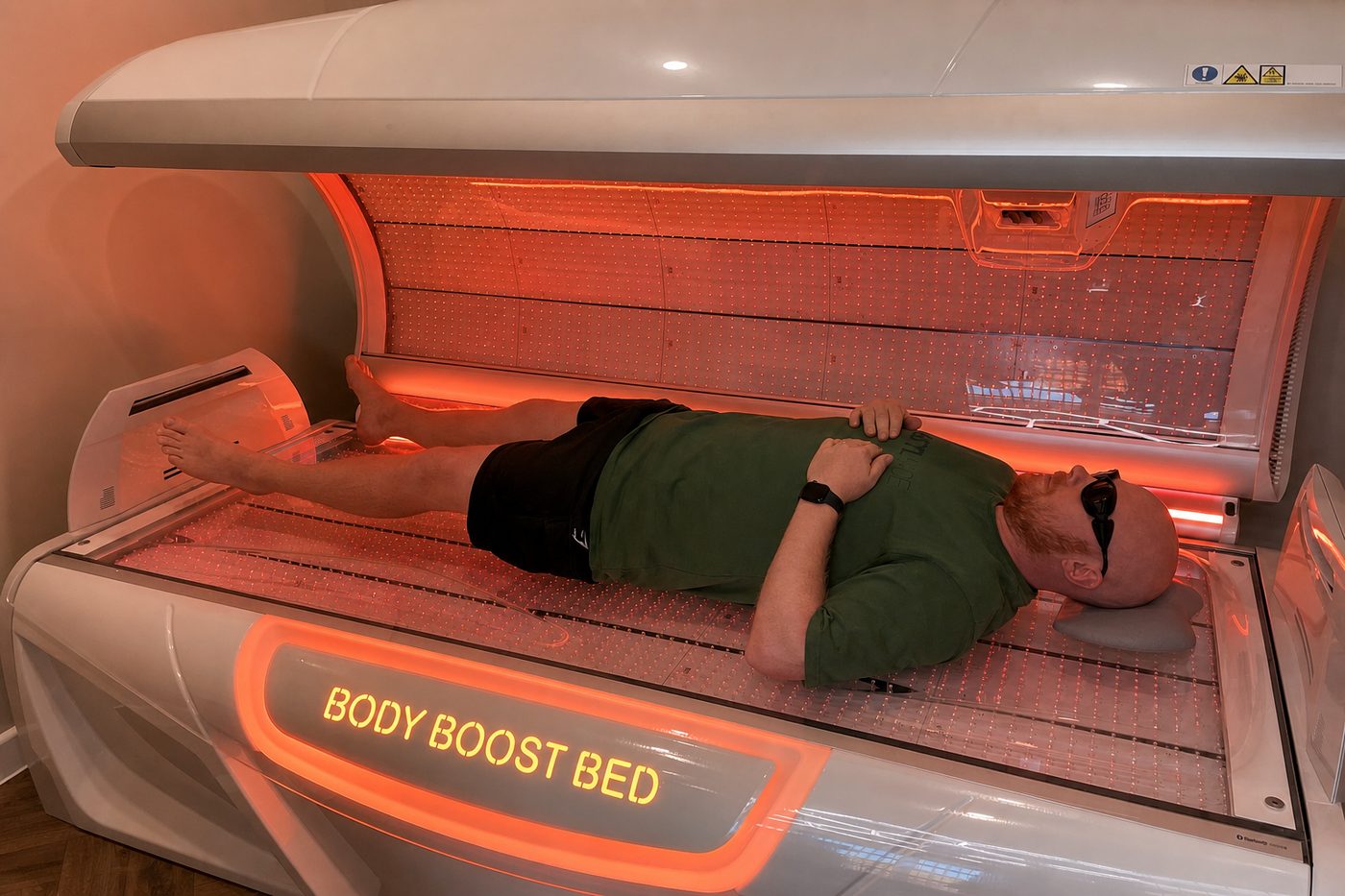
A session couldn't be simpler. You lie on the contoured bed, we give you eye protection and select a pre-set programme, recovery, skin, pain or wellness, and the LEDs do the rest. There's no heat and nothing to feel beyond a comfortable glow; most sessions last around ten to twenty minutes. You get up and carry on with your day immediately, no redness, no downtime. It's the most low-effort treatment in the suite, which is exactly why people use it consistently.
Who it's not for: safety and contraindications
Red light is very safe and well tolerated, but a few cautions apply. Speak to us or your own medical provider first if any of the following apply: you take medication or use products that cause light sensitivity (some antibiotics, retinoids, certain supplements such as St John's Wort); you have a photosensitive condition such as lupus; you have photosensitive epilepsy; you have any undiagnosed skin lesion, or a history of skin cancer; or you are pregnant and would prefer to err on the side of caution. Always use the eye protection provided. If you're unsure, ask, and we'll check.
Why we offer a medical-grade red light bed
Light therapy is one of the few "wellness" tools with a mechanism I find genuinely persuasive as a clinician: it does measurable work at the level of the mitochondria, and it has a real evidence base across skin, recovery and pain rather than a single hopeful study. That's why we chose a full-body, CE-marked medical device: the dose is consistent, the coverage is complete, and the certification means it's built to a defined standard. It's also the most versatile tool we have: skin, recovery and pain from one effortless session, which makes it the easiest place for many people to start.
How to try red light therapy in Milton Keynes
Red light therapy is part of our wider recovery suite and the Recover pillar at Hanbury Health, available from £39. It works well on its own and pairs naturally with the rest of the suite in a single visit. Full pricing and membership options are on our recovery page.
Frequently asked questions
What is red light therapy?
Red light therapy, or photobiomodulation, uses specific wavelengths of light (red and near-infrared, plus blue for skin) to stimulate the mitochondria in your cells to produce more energy, supporting skin health, recovery and reduced pain. It's heat-free and non-invasive.
What is red light therapy good for?
The best-supported uses are skin health and anti-ageing (collagen and complexion), muscle recovery and reduced soreness, and easing pain and inflammation. Our full-body bed covers all three in one session.
Does red light therapy actually work?
For muscle soreness and skin quality, the evidence is relatively strong, a meta-analysis found around a 43% reduction in muscle soreness versus placebo, and controlled studies show improved collagen and complexion over weeks. Results build with repeated sessions, and dose and wavelength matter.
How long is a red light session and does it feel like anything?
Around ten to twenty minutes. It's heat-free, so you feel nothing beyond a comfortable glow, and there's no redness or downtime afterwards.
Is red light therapy safe? Who should avoid it?
It's very safe and well tolerated. Take extra care if you use light-sensitising medication, have a photosensitive condition, photosensitive epilepsy, an undiagnosed skin lesion or history of skin cancer, or are pregnant, check with a medical provider first. Always wear the eye protection provided.
How often should I use it?
Skin and recovery benefits build with regular, repeated sessions rather than a single visit. We'll suggest a sensible frequency for your goal.
How much does red light therapy cost in Milton Keynes?
It's part of our recovery suite, available from £39. Current pricing and membership options are on our recovery page.
Where can I try a red light bed in Milton Keynes?
A full-body, medical-grade red light bed is available at Hanbury Health in Milton Keynes, on its own or alongside the rest of our recovery suite. You can book through our website.
Book your recovery visit in Milton Keynes
To try red light therapy, book a visit at Hanbury Health in Milton Keynes, a full-body, medical-grade light bed from £39, on its own or alongside the rest of our recovery suite.
Medical disclaimer: Red light therapy (photobiomodulation) is used here as a general skin, recovery and wellbeing tool. It is not intended to diagnose, treat, cure or prevent any disease, and individual results vary. This article is for general information and is not medical advice. Always consult a qualified healthcare professional about your individual circumstances, particularly if you take light-sensitising medication, have a photosensitive condition, or have any undiagnosed skin lesion.
Written by Prof Arul Ramasamy MA PhD MBA FRCS(Tr+Orth), Consultant Orthopaedic Surgeon and Medical Director, Hanbury Health, Milton Keynes.