
Recovery
Does recovery therapy help fibromyalgia? What the evidence actually shows
The short version
- Hyperbaric oxygen therapy (HBOT) has the strongest evidence of the group. A meta-analysis of four randomised trials found significant improvement in overall symptom severity and tender point count.
- Full-body red light (photobiomodulation) has several randomised trials behind it, with meta-analysis showing improvement in pain, tender points and fatigue.
- Whole-body vibration can improve quality of life, pain and fatigue during a course of treatment, though the evidence is low-certainty and gains fade without ongoing sessions.
- Whole-body cryotherapy improved quality of life in short, structured blocks of sessions rather than as an occasional treat.
- None of the trials tested these four together as a single circuit, so a combined programme is evidence-informed rather than a single validated protocol.
- Cold and pressure changes need proper screening in fibromyalgia, since central sensitisation can mean a stronger reaction to a stimulus than in someone without the condition.
If you live with fibromyalgia, you have probably been offered every recovery treatment under the sun, most with no real evidence behind them. A handful genuinely do have trial data. Hyperbaric oxygen, full-body red light, whole-body vibration and whole-body cryotherapy each have randomised trials specific to fibromyalgia, and the results are encouraging when the treatments are dosed the way the trials dosed them.
What does the evidence say about hyperbaric oxygen and fibromyalgia?
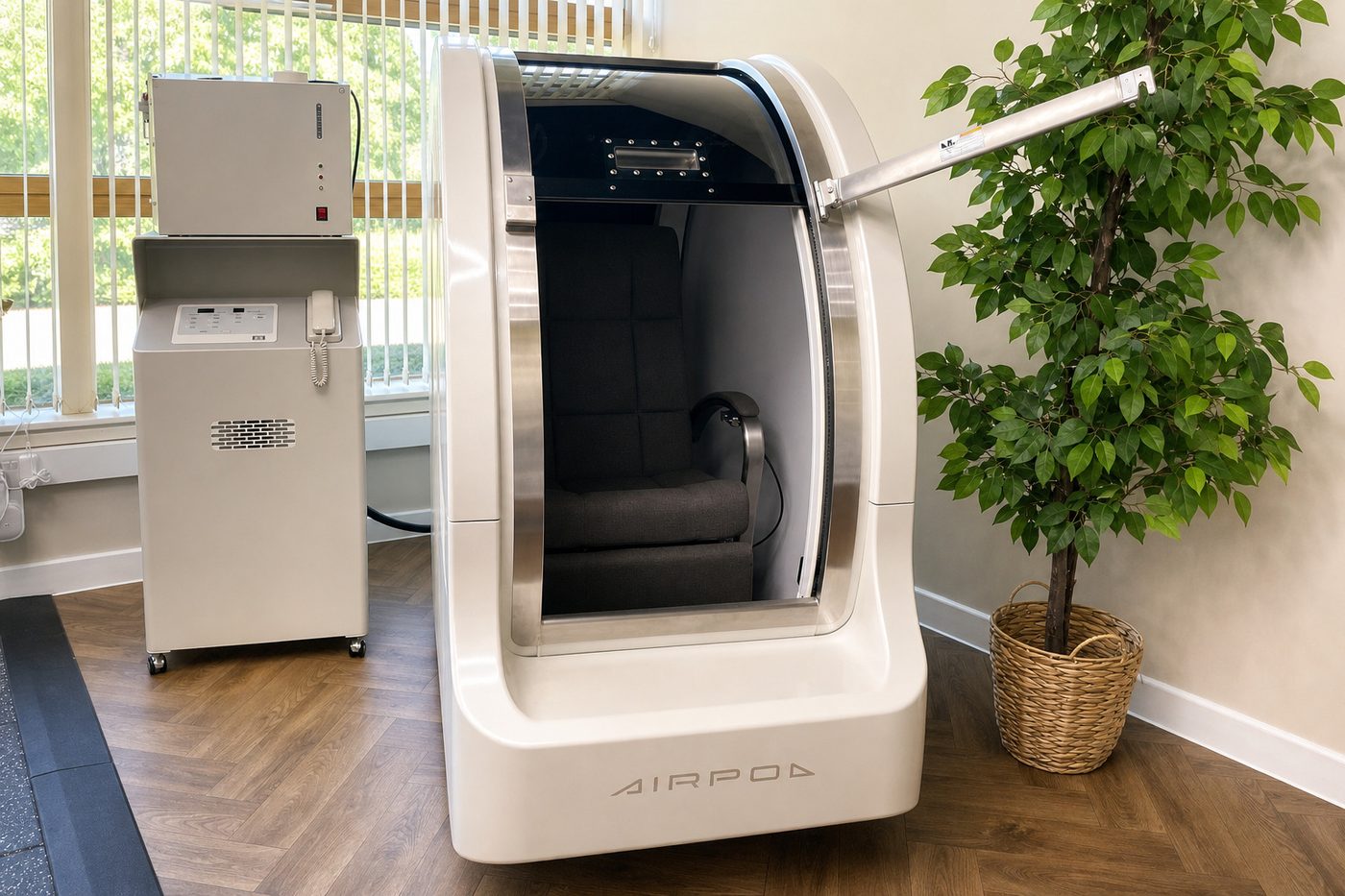
Hyperbaric oxygen therapy involves breathing concentrated oxygen in a pressurised chamber, and it has the most robust trial evidence of any recovery treatment for fibromyalgia. A 2023 meta-analysis pooling four randomised controlled trials and 163 participants found significant improvement on the Fibromyalgia Impact Questionnaire, a standard measure of overall symptom severity, and in tender point count by the end of treatment. In that pooled analysis the pain-only outcome did not reach statistical significance on its own, and mild side effects, mostly related to ear pressure, were more common in the treated group, so the honest summary is meaningful improvement in overall symptom burden rather than a guaranteed drop in pain scores. Separate trials have also reported benefit in fibromyalgia linked to traumatic brain injury and in fibromyalgia with a history of childhood trauma, with brain imaging in some studies showing measurable changes alongside the symptom improvement.
The trials used a demanding protocol: sessions most days of the week, for roughly 90 minutes, often building to 40 to 60 sessions in total. That is a course commitment, not a single visit, and it is worth knowing that going in.
What does the evidence say about full-body red light therapy and fibromyalgia?
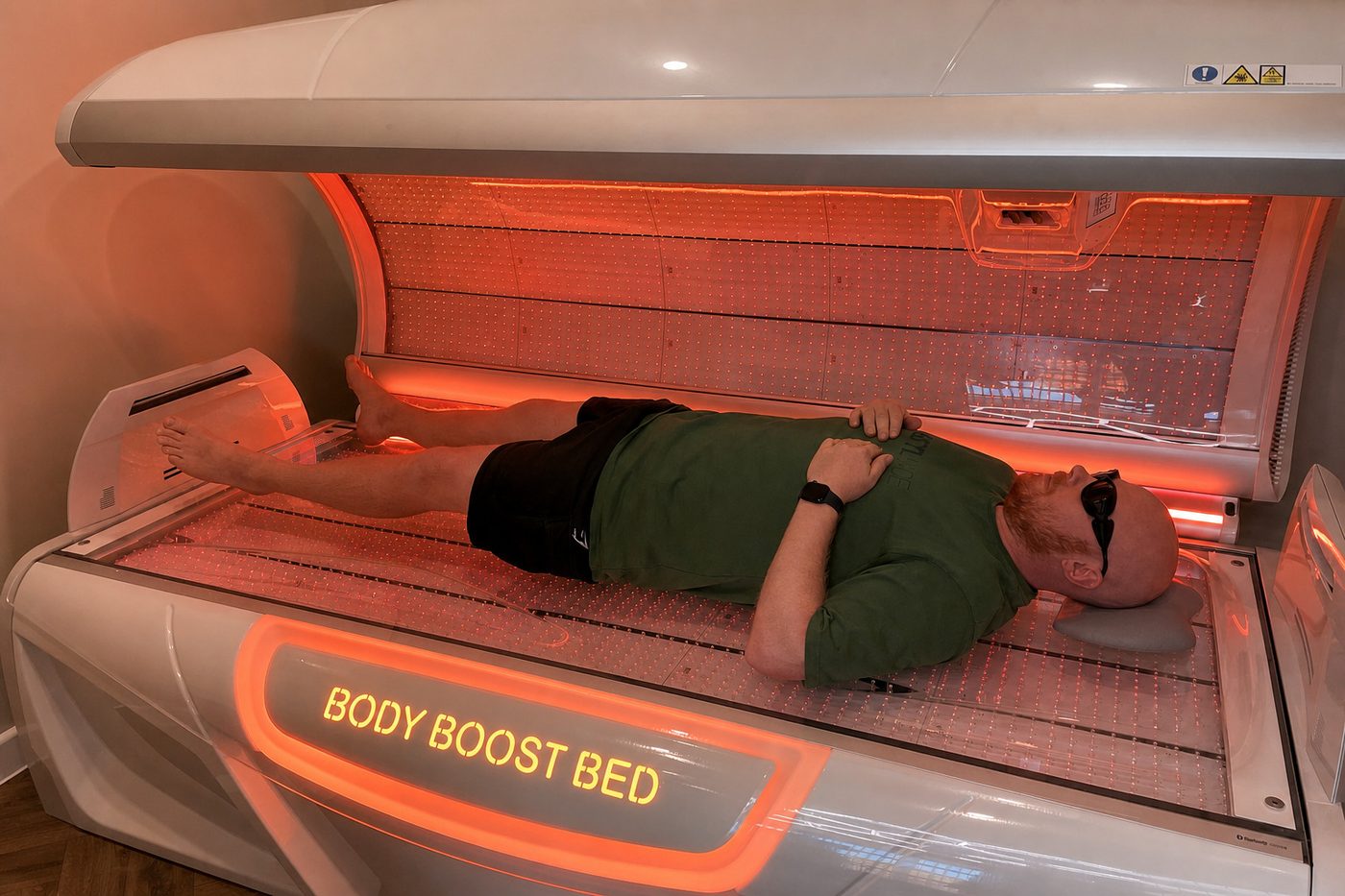
Photobiomodulation, delivered by low-level laser, infrared or LED light, has several randomised trials specific to fibromyalgia. A systematic review and meta-analysis of nine randomised trials covering 325 patients found that light therapy significantly improved Fibromyalgia Impact Questionnaire scores, pain, tender point count and fatigue compared with placebo light, and that combining phototherapy with an exercise programme added benefit over exercise alone. A 2025 umbrella review of the wider evidence rated the support for fibromyalgia fatigue as moderate certainty, which is a relatively strong grade in this field.
Most of those trials treated specific areas rather than the whole body. The practical reason a full-body chamber is a different proposition to a small handheld panel is simple coverage: fibromyalgia pain is widespread by definition, so a device that treats far more tissue in one session matches the nature of the condition better than spot-treating one region at a time.
What does the evidence say about whole-body vibration and fibromyalgia?
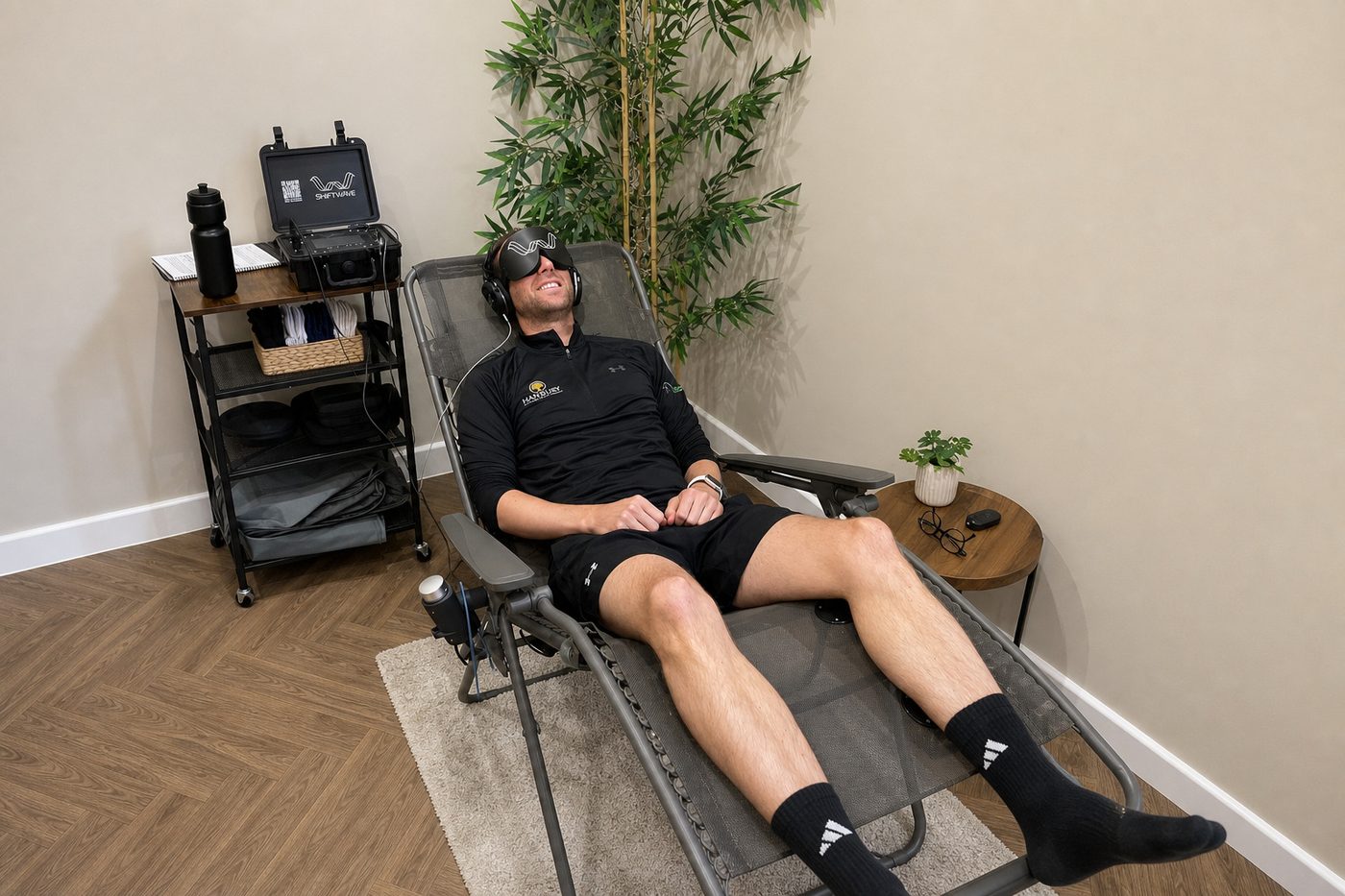
Whole-body vibration platforms have fibromyalgia-specific randomised trials behind them, gathered together in a Cochrane review. That review pooled four small trials involving 150 women and found that whole-body vibration, usually combined with other exercise, improved quality of life, pain, fatigue and stiffness during the programmes. The important caveat is that the Cochrane authors graded the certainty of this evidence as very low because the trials were small, and the durability of benefit after sessions stop was not established. In practice that means vibration therapy looks like something that needs to stay part of an ongoing routine rather than a course you complete once and expect to hold.
What does the evidence say about cryotherapy and fibromyalgia?
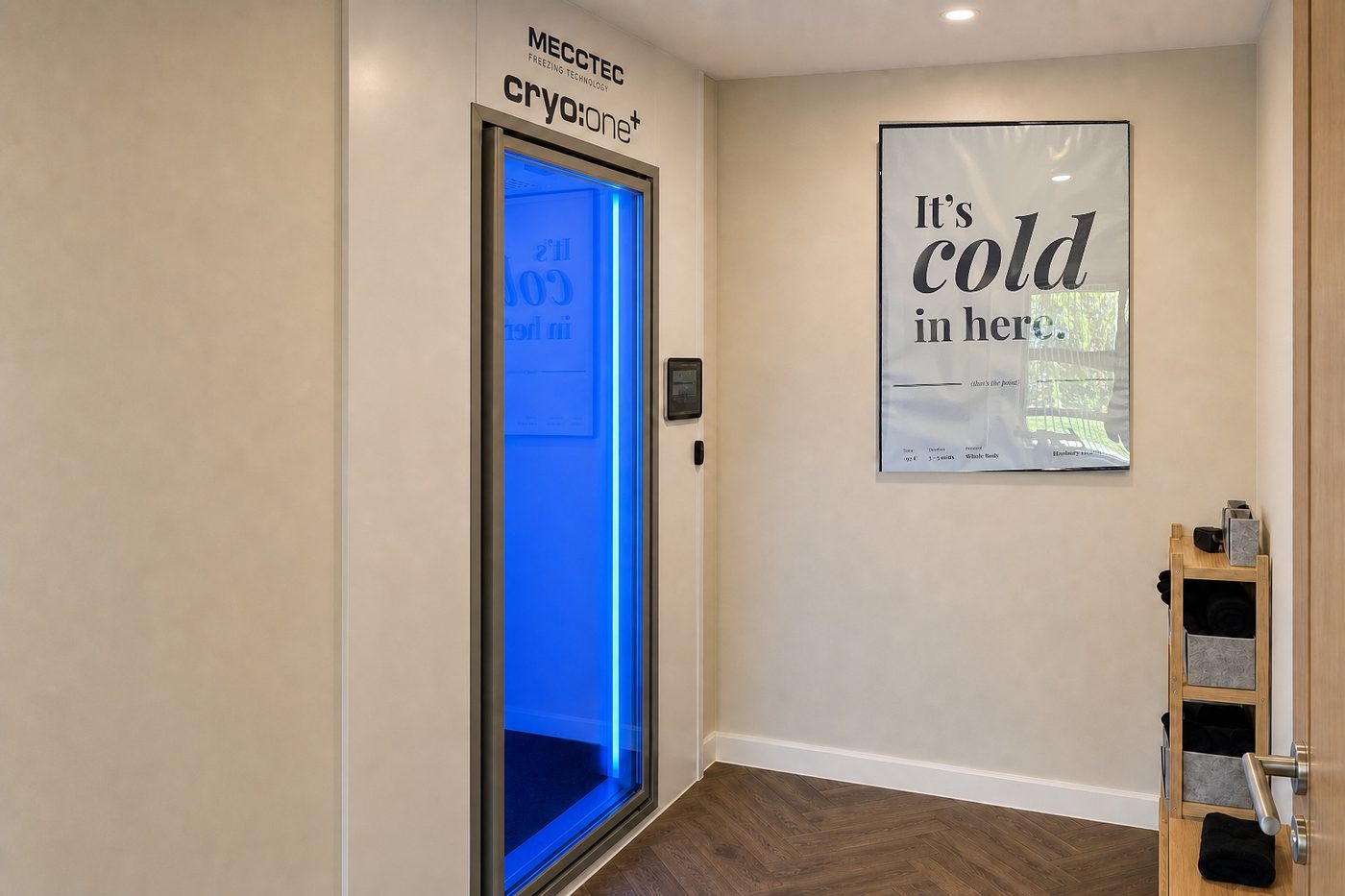
Whole-body cryotherapy has been tested in fibromyalgia in a randomised controlled trial using 10 short sessions, a couple of minutes each, over roughly a week. Compared with usual care alone, the cryotherapy group reported significantly improved health-related quality of life, and that improvement was still present one month after the sessions ended. Cryotherapy has also been studied as an add-on to wider rehabilitation programmes, where it appears to add benefit on top of standard care. A 2023 international safety review concluded that the risks of genuine whole-body cryotherapy are within acceptable limits when recognised contraindications and screening are respected.
Fibromyalgia often comes with heightened sensitivity to cold, so this is the treatment that needs the most careful, gradual introduction of the four.
Is there an evidence-based fibromyalgia recovery circuit at Hanbury Health in Milton Keynes?
We have built a circuit that reflects the dosing used in these trials as closely as a real weekly routine allows, while respecting that fibromyalgia involves a sensitised nervous system that responds to cumulative load, not just single sessions.
A typical structure looks like an induction phase in the first couple of weeks, with hyperbaric oxygen three times a week alongside full-body red light, and cryotherapy introduced cautiously and briefly once tolerance is confirmed. After that, most people move to a maintenance rhythm: hyperbaric oxygen twice a week, red light once or twice, vibration therapy once, and cryotherapy every five to seven days rather than daily. Rest days are built in deliberately, since fibromyalgia symptoms can flare from cumulative exertion even when no single session felt like too much.
This is not a copy of any one trial protocol. It is a sequence designed by our team in Milton Keynes, informed by the dosing that produced results in the research, and adjusted around what a real weekly life can sustain. You can see the full range of recovery therapy at Hanbury Health and how the sessions fit together.
How do I book a fibromyalgia recovery circuit at Hanbury Health?
Every circuit starts with a recovery consultation, booked through Momence, where we screen for cold sensitivity, barotrauma risk and your current symptom pattern before building your weekly plan. Commitment grows at your pace: many people start with one or two modalities and add to the circuit once they know how their body responds. If you want to read more first, our guide to recovery therapy in Milton Keynes and our guide to your first cryotherapy session in Milton Keynes cover what to expect.
Why Hanbury Health is different
The evidence behind these treatments holds true wherever they are delivered. What differs at Hanbury Health is that nothing you tell us in the recovery suite has to be repeated somewhere else. If a physio expert notices something during your assessment, or your recovery session surfaces a pattern worth flagging, that goes straight into a shared record the whole team can see, from physiotherapy through to recovery and healthspan medicine. For a condition like fibromyalgia, where symptoms cross so many systems, having one team follow the same thread matters more than any single piece of equipment.
Frequently asked questions
Can recovery therapy cure fibromyalgia?
No. None of the treatments discussed here are a cure, and no honest provider should claim one. The trial evidence points to meaningful symptom improvement, not remission.
How long before I would notice a difference?
The trials measured outcomes at the end of a course of treatment, typically several weeks, rather than after a single session. We would expect the same here.
Is cryotherapy safe if I have fibromyalgia?
Often yes, but fibromyalgia can involve heightened cold sensitivity, so we always start conservative and screen properly before your first session.
Do I need to do all four treatments?
No. The circuit above is a suggested full programme, but many people start with one or two elements, most often red light and hyperbaric oxygen, and build from there.
Is hyperbaric oxygen uncomfortable?
Most people tolerate it well. The main sensation is similar to the ear-pressure change on a flight, which we talk you through before your first session.
Will this replace my existing fibromyalgia treatment?
No. This sits alongside your GP or rheumatology care, not instead of it, and we will always ask what else you are being treated with before building your plan.
Can I do this circuit in Milton Keynes without travelling to a specialist hospital-style unit?
Yes. Hyperbaric oxygen, full-body red light, whole-body vibration and whole-body cryotherapy are all available together at Hanbury Health in Milton Keynes.
References
- Cao C, Li Q, Zhang X, Varrassi G, Wang H. Effectiveness of Hyperbaric Oxygen for Fibromyalgia: A Meta-Analysis of Randomized Controlled Trials. Clinics and Practice, 2023;13(3):583-595.
- Yeh SW, Hong CH, Shih MC, Tam KW, Huang YH, Kuan YC. Low-Level Laser Therapy for Fibromyalgia: A Systematic Review and Meta-Analysis. Pain Physician, 2019;22(3):241-254.
- Son Y, Lee H, Yu S, et al. Effects of photobiomodulation on multiple health outcomes: an umbrella review of randomized clinical trials. Systematic Reviews, 2025;14:160.
- Bidonde J, Busch AJ, van der Spuy I, Tupper S, Kim SY, Boden C. Whole body vibration exercise training for fibromyalgia. Cochrane Database of Systematic Reviews, 2017;(9):CD011755.
- Vitenet M, Tubez F, Marreiro A, Polidori G, Taiar R, Legrand F, Boyer FC. Effect of whole body cryotherapy interventions on health-related quality of life in fibromyalgia patients: A randomized controlled trial. Complementary Therapies in Medicine, 2018;36:6-8.
- Legrand FD, Dugue B, Costello J, et al. Evaluating safety risks of whole-body cryotherapy/cryostimulation (WBC): a scoping review from an international consortium. European Journal of Medical Research, 2023;28:387.
Book a recovery consultation
About the author: Prof Arul Ramasamy is a consultant orthopaedic surgeon and a founder of Hanbury Health. He holds a PhD in bioengineering from Imperial College London, where he is a Visiting Professor, and is a Fellow of the Royal College of Surgeons (Trauma and Orthopaedics). He leads Hanbury's approach to recovery, performance and long-term health.
General information, not medical advice. Written by Prof Arul Ramasamy. Medically reviewed by Prof Arul Ramasamy MA PhD MBA FRCS(Tr+Orth). Last reviewed: 14 August 2026.
Related insights
Recovery
Compression boots or the Shiftwave chair: which do you actually need?
Heavy legs point to the compression boots, a wired nervous system to the Shiftwave chair. How to tell, and why the £75 circuit covers both.
Ramasamy8 min readRead the article
Recovery
How often should you do the Recovery Circuit, and how do you build it into a routine?
Once or twice a week suits most people. How to find your own rhythm with the £75 Recovery Circuit, and when to add the rest of the suite.
Ramasamy8 min readRead the article
Recovery
What does a Hyrox-specific recovery routine actually look like in Milton Keynes?
Match what you feel after a Hyrox race to the right tool: heavy legs, a wired nervous system, localised DOMS and cumulative training-block fatigue.
Ramasamy9 min readRead the article
Stay informed
More from the Hanbury team.
New articles on recovery, movement, physiotherapy and performance, sent when there's something worth reading. No spam, unsubscribe any time.