
Recovery
What does a Hyrox-specific recovery routine actually look like in Milton Keynes?
The short version
- You will understand why your legs feel so heavy after Hyrox, and what actually helps them feel lighter again.
- You will know what to do about the wired, cannot-switch-off feeling that often follows race day, separate from muscle soreness.
- General next-day stiffness, localised DOMS in quads and shoulders, and deep training-block fatigue each call for something different.
- An honest answer on grip and forearm fatigue from the farmers carry and sled pull, including where the recovery suite cannot help directly.
- You will know exactly how to book, what the £75 Recovery Circuit covers, and when it is worth adding more.
If you have raced Hyrox, you already know the feeling the next morning: legs that will not quite fold under you on the stairs, shoulders that ache from the wall balls, and a mind still slightly wired from race-day adrenaline. A Hyrox-specific recovery routine matches what you are feeling to the right tool, instead of reaching for the same ice bath or foam roller regardless of what is actually sore. At Hanbury Health in Milton Keynes, that means working through the recovery suite in an order that follows what the race did to your body, station by station.
The goal is not a faster comeback for its own sake. It is not spending the week after a race hobbling around and dreading stairs.
What does a Hyrox race actually do to your body?
Hyrox is built to be brutal in a specific way. The race alternates 8km of running, split into eight 1km segments, with eight fixed stations in the same order every time: SkiErg (1000m), sled push (50m), sled pull (50m), burpee broad jumps (80m), rowing (1000m), farmers carry (200m), sandbag lunges (100m) and wall balls (100 reps), always finishing on the wall balls after that final run.
Six of the eight stations lean heavily on your legs, on top of 8km of running. Two, the farmers carry and the sled pull, hammer your grip and forearms. And the whole thing runs on adrenaline that does not switch off the moment you cross the line.
That is why generic recovery advice, written for a 5k or a gym session, does not quite fit. A Hyrox-specific routine has to account for leg-dominant fatigue, grip fatigue, and a nervous system still running hot, not just general soreness.
Why do your legs feel so heavy after Hyrox?
Because they have earned it. Between the running, both sled stations, the lunges, the burpee broad jumps and the wall balls, your legs are doing most of the race's total work. That heaviness, tired all the way through rather than sore in one spot, is the classic sign of a leg-dominant event.
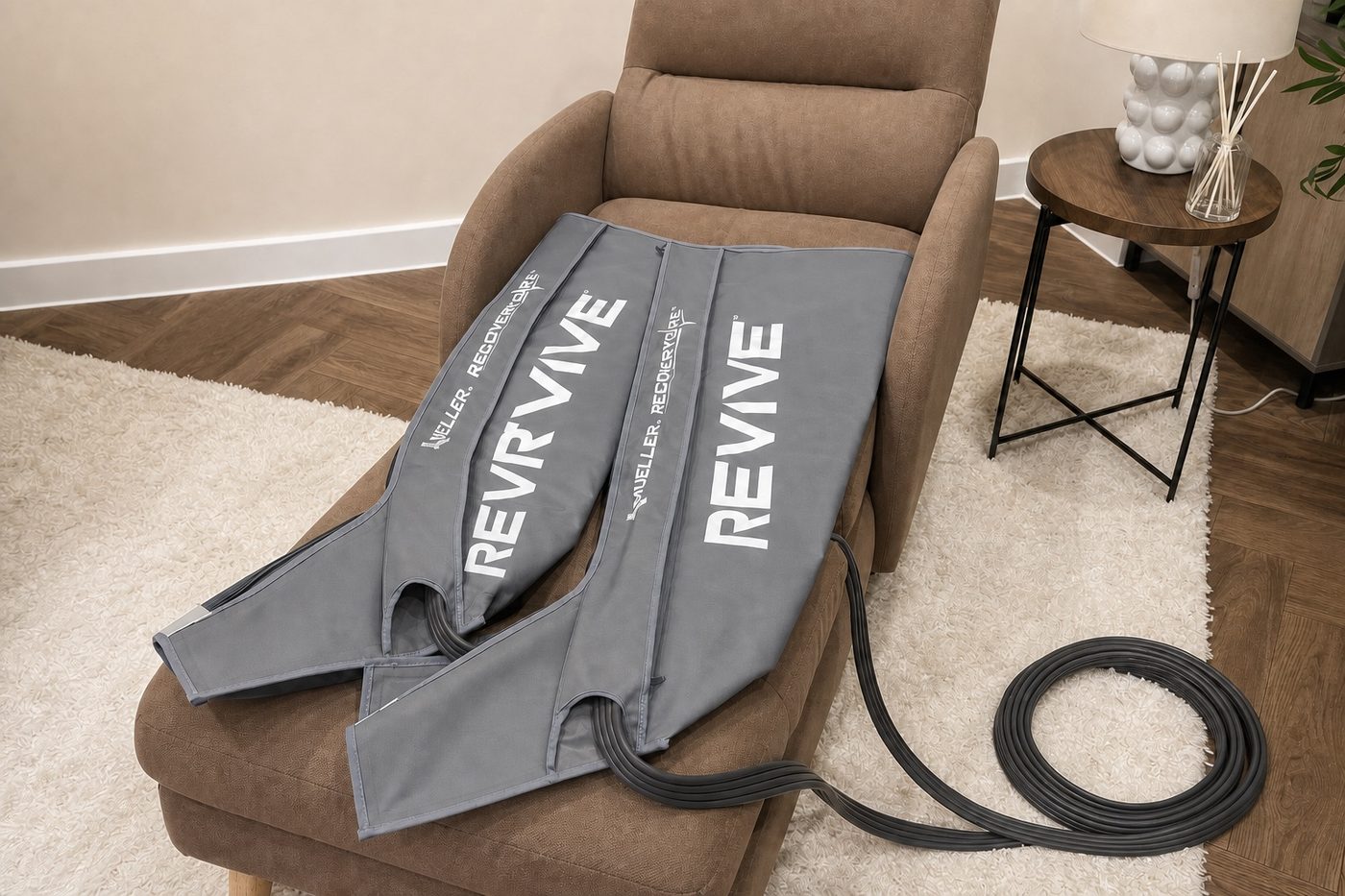
This is where the compression boots come in. They use sequential pneumatic compression, inflating rhythmically from your feet upward, designed to help move fluid back out of tired legs rather than leaving it pooled around your ankles and calves. A 2014 meta-analysis in the British Journal of Sports Medicine looked at compression garments across a range of exercise-damage studies and found a moderate benefit for reducing the severity of delayed-onset muscle soreness. It is not a dramatic effect, but it is a real one.
If you have raced back-to-back or trained through a particularly heavy block, the lymphatic drainage compression suit is worth knowing about too, a full-body version of the same idea for the days when your legs feel properly swollen rather than just tired.
Why can't you switch off after a race?
Race-day adrenaline does not disappear the moment you stop moving. Plenty of Hyrox athletes feel wired, restless, or oddly unable to relax for hours after finishing, on top of the physical fatigue. That is a different problem to sore legs, and it needs a different answer.
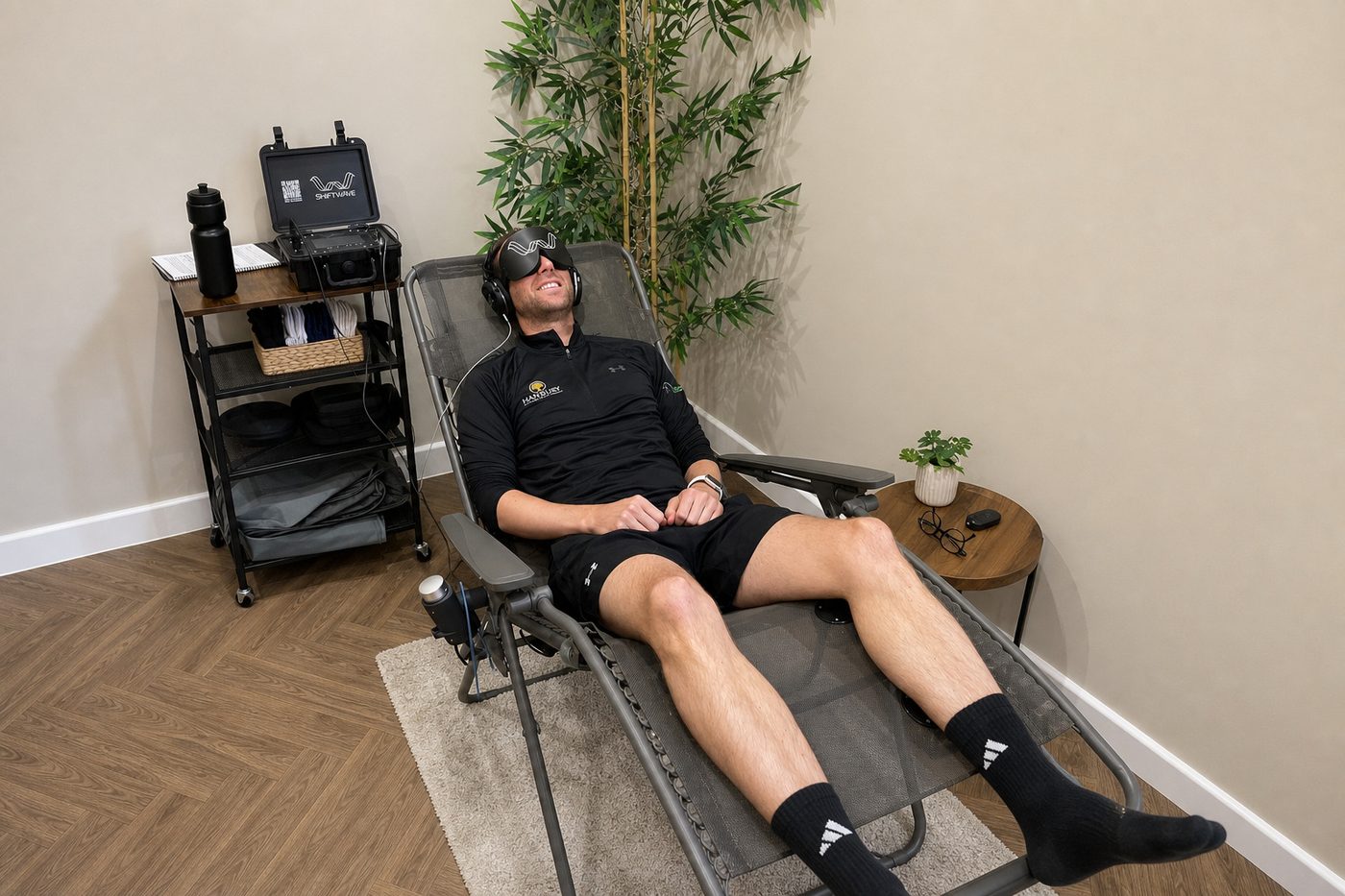
The Shiftwave chair is built for exactly this. It uses pressure waves, gentle vibration and guided breathing to help bring a keyed-up nervous system back down, rather than trying to fix anything muscular. If you have ever lain awake the night after a race with your heart still going and your mind replaying your splits, this is the piece of the recovery suite aimed at that feeling. Our comparison of compression boots and the Shiftwave chair goes into how the two differ.
What helps general next-day stiffness?
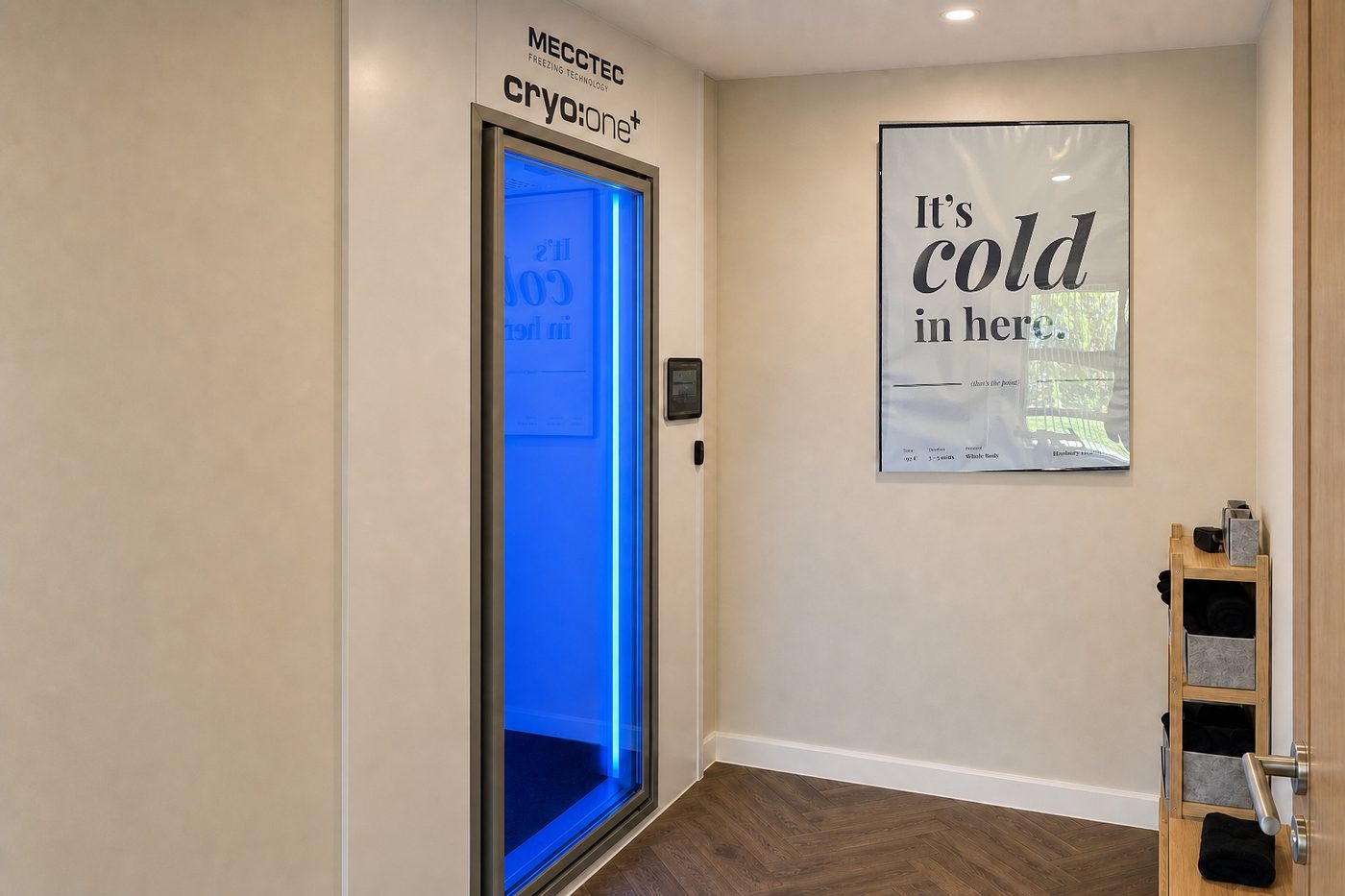
Stiffness that is not localised, where everything just feels tight first thing the morning after, tends to respond well to a mix of heat and cold rather than either alone. Contrast therapy at Hanbury Health pairs an infrared sauna session with a precisely timed ice shower, alternating warmth that encourages blood flow with a sharp cold hit. Whole-body cryotherapy, at around minus 90C for three to four minutes, works on a similar principle from the cold end alone, a shorter, sharper option.
Worth being straight with you here: research on cold-based recovery for muscle soreness specifically is genuinely mixed. A Cochrane review of whole-body cryotherapy for muscle soreness found the existing trials too small and low quality to confirm a reliable soreness-reducing effect. What people consistently report is how these sessions feel in the moment, sharp, invigorating, a clear marker that the hard session is now behind you. That is a legitimate reason to use them, even without a guaranteed measurable effect on next-day soreness.
What about the soreness in your quads, glutes and shoulders?
This is DOMS in the classic sense, localised soreness where you took the most direct load: quads and glutes from the lunges and running, shoulders from the wall balls and SkiErg. For this, the medical-grade red light bed is the tool built for the job, full-body photobiomodulation, no heat, no downtime, from £39. More on the evidence in our guide to red light therapy in Milton Keynes. If you are weighing up options for soreness in general, our guide to the best recovery therapy for DOMS compares them side by side.
What if you're training through a full Hyrox season, not just one race?
One race is one thing. A full block of Hyrox training, or back-to-back events a few weeks apart, is a different demand, because you are rarely starting fresh. This is where mild hyperbaric oxygen therapy, combined with molecular hydrogen, sits in the recovery suite, built around pressurised oxygen to support repair over a training block rather than fix one race's soreness. Think of it as a periodic addition through a heavy season, not something you would book after every workout.
What about grip and forearm fatigue from the sled pull and farmers carry?
Here is the honest answer: nothing in the recovery suite specifically targets grip and forearm fatigue. It is a genuinely distinct demand from the leg-dominant fatigue the rest of the race produces, and while compression, cold and red light have general benefits for tired muscle tissue, none is built for grip. Forearm mobility and grip training between sessions remain your best tools here. We would rather say that plainly than stretch a claim to fit.
What does a Hyrox recovery routine actually look like in Milton Keynes?
Hyrox training has grown into a genuine community around Milton Keynes, with athletes drilling station-specific sessions across the city before racing regionally. What is often missing locally is somewhere to recover that understands the sport's specific demands, rather than treating it as general cardio.
The table below sets out how a Hyrox-specific routine at Hanbury Health maps against what the race actually does, station by station.
| What the race does | How it tends to feel | What helps at Hanbury Health |
|---|---|---|
| Sled push, sled pull, lunges, burpee broad jumps, wall balls | General systemic soreness and inflammation | Whole-body cryotherapy |
| 8km of running plus six leg-dominant stations | Heavy, swollen legs | Compression boots, with the lymphatic drainage suit for the worst days |
| Race-day adrenaline, start to finish | Wired, restless, hard to switch off | The Shiftwave chair |
| The race as a whole | General next-day stiffness | Contrast therapy (infrared sauna plus ice shower) |
| Wall balls, SkiErg, lunges, running | Localised DOMS in quads, glutes and shoulders | The red light bed |
| A full training block or back-to-back races | Slower repair, cumulative fatigue | Mild hyperbaric oxygen therapy with molecular hydrogen |
| Farmers carry, sled pull | Grip and forearm fatigue | Not specifically targeted, general mobility and grip work is your best bet |
For most people, most weekends, the £75 Recovery Circuit (cryotherapy, then compression boots, then the Shiftwave chair) covers the two biggest post-race demands, heavy legs and a wired nervous system, in one guided visit close to home in Milton Keynes. Our guide to how often to do the Recovery Circuit covers how to build it into a training week.
How do you book Hyrox recovery at Hanbury Health?
Booking is straightforward. The £75 Recovery Circuit is the sensible base booking after most races or hard station sessions: one guided visit, three systems, in the order that suits how most Hyrox athletes feel afterwards.
The rest of the recovery suite, contrast therapy, mild hyperbaric oxygen therapy, the red light bed and the lymphatic drainage suit, is separate and bookable individually. Think of these as deliberate additions for a heavier training block, not things you need every time. Full pricing sits in our guide to recovery therapy in Milton Keynes.
Why Hanbury Health is different
If you are racing Hyrox, you probably already train by numbers. You know your SkiErg split, your sled push time, roughly where you are bleeding seconds against last race. That same instinct, test something, work on it, track whether it is actually improving, is how Hanbury Health's experts think about recovery too.
A structured approach starts from how you actually feel and what you are training for, matches the tools to that specific demand, and tracks whether your training holds up better through the block as a result. Same mindset you already bring to your splits, pointed at recovery.
Frequently asked questions
How soon after a Hyrox race should I use the recovery suite?
There is no strict window. Many athletes come in within a day or two of racing and still get real benefit from the Recovery Circuit. Getting in sooner is fine too, and there is no evidence that waiting is necessary.
Is the £75 Recovery Circuit enough on its own?
For most people, most of the time, yes. It covers the two biggest post-race issues, heavy legs and a wired nervous system, in one visit. The extended suite is for specific soreness patterns or heavier training blocks, not a mandatory upgrade.
Does cryotherapy actually reduce DOMS after Hyrox?
Be cautious of strong claims here. A Cochrane review of whole-body cryotherapy found the existing evidence too limited to confirm a reliable soreness-reducing effect. Most people use it for how it feels in the moment, sharp and invigorating, rather than as a guaranteed fix for soreness.
What is the difference between the Shiftwave chair and compression boots?
Compression boots work on your legs directly, helping move fluid out of tired muscle tissue. The Shiftwave chair works on your nervous system, using pressure, vibration and breathing to help you come down from race-day adrenaline. They solve different problems, which is why the Recovery Circuit includes both.
Will anything here help my grip after the farmers carry and sled pull?
Not specifically. Nothing in the recovery suite is built for grip and forearm fatigue directly. Mobility work and grip training between sessions remain your best approach.
Is there somewhere to do Hyrox recovery in Milton Keynes without travelling further afield?
Yes. The recovery suite at Hanbury Health is based in Milton Keynes and built around this kind of station-by-station demand, so you do not need to travel elsewhere in the region.
Can I use the recovery suite even if I am not racing Hyrox, just training for it?
Yes. Plenty of people use it during a hard training block, not only after races. The same logic applies: match what you are feeling to the right tool.
References
- Hill J, et al. Compression garments and recovery from exercise-induced muscle damage: a meta-analysis. British Journal of Sports Medicine, 2014.
- Costello JT, et al. Whole-body cryotherapy for preventing and treating muscle soreness after exercise. Cochrane Database of Systematic Reviews, 2015.
Ready to put this into practice?
About the author: Prof Arul Ramasamy is a consultant orthopaedic surgeon and a founder of Hanbury Health. He holds a PhD in bioengineering from Imperial College London, where he is a Visiting Professor, and is a Fellow of the Royal College of Surgeons (Trauma and Orthopaedics). He leads Hanbury's approach to recovery, performance and long-term health.
General information, not medical advice. Written by Prof Arul Ramasamy. Medically reviewed by Prof Arul Ramasamy MA PhD MBA FRCS(Tr+Orth). Last reviewed: 19 August 2026.
Related insights
Recovery
Compression boots or the Shiftwave chair: which do you actually need?
Heavy legs point to the compression boots, a wired nervous system to the Shiftwave chair. How to tell, and why the £75 circuit covers both.
Ramasamy8 min readRead the article
Recovery
How often should you do the Recovery Circuit, and how do you build it into a routine?
Once or twice a week suits most people. How to find your own rhythm with the £75 Recovery Circuit, and when to add the rest of the suite.
Ramasamy8 min readRead the article
Recovery
Can recovery therapy help you sleep better and feel less wound up in Milton Keynes?
For anyone wound up by ordinary life rather than training. How guided nervous-system down-regulation helps sleep, and where to start.
Ramasamy8 min readRead the article
Stay informed
More from the Hanbury team.
New articles on recovery, movement, physiotherapy and performance, sent when there's something worth reading. No spam, unsubscribe any time.